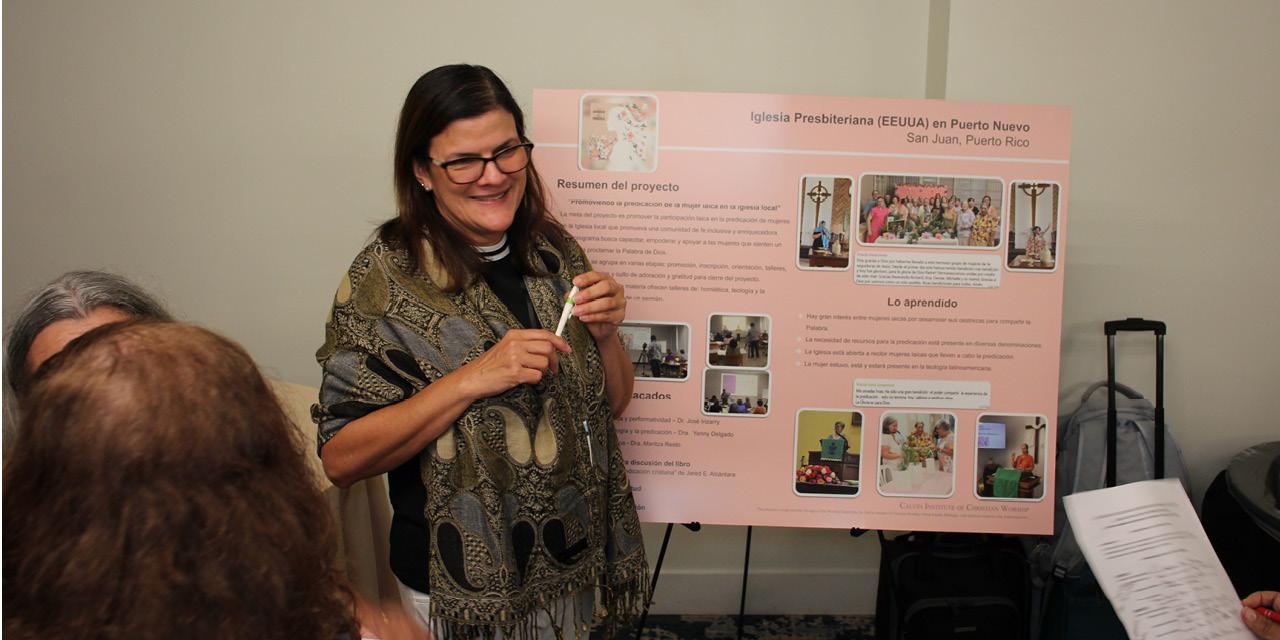
The project, launched by the Presbyterian Church of Puerto Nuevo in San Juan, Puerto Rico, has not only transformed the congregation’s internal culture but has also begun to inspire other churches and denominations across the island.
For Richard Rojas, the church’s pastor, the initiative was driven by both history and need.
“There were two important reasons that motivated us,” he said. “One was the representation of women in the pulpit. It’s important that women have a greater role in preaching and leadership. The other was the growing need to fill pulpits as more churches are left without pastors. We needed to respond to that reality, and that’s where the idea for this project began.”
A theological shift
Beyond addressing a practical shortage of preachers, the initiative carries theological weight. “Historically, our pulpits have been occupied by men,” Rojas said. “Our congregations are mostly made up of women who listen while men preach. But Jesus included women in his ministry, and the New Testament lifts up examples like Priscilla. We want to place women at the center of the church—not as appendages or assistants, but as protagonists and role models for new generations.”
An overwhelming response
When Denisse Santiago, one of the project’s coordinators, helped launch the first workshop, she didn’t expect the level of enthusiasm it would generate.
“We planned for a small number of women, but the registration filled up quickly,” Santiago said. “We even had women from other denominations sign up. The project was very well received. The participants were eager to learn, and many have already been invited to preach in other churches. What was planted has already begun to bear fruit.”
Santiago, who also preaches as part of the program, said the workshops gave participants confidence and tools to engage Scripture more deeply.
“We learned practical methods to study the text and ensure that theology remains central when we preach,” she said. “You never stop learning—the theory, the practice, the delivery—it all grows with experience.”
Challenges and opportunities
The project was not without its challenges, according to Ana López, another lay leader involved in the effort.
“The biggest challenge was the level of demand,” López said. “We had space for a certain number of people, but many more wanted to participate. We also realized we needed to think beyond our denomination because the need is much greater than we expected. The project reached further than we imagined.”
Despite those limits, López said, the impact has been multigenerational. “We had participants ranging in age from their forties to one woman who was nearly eighty,” she said. “For the older participants, it was deeply empowering. They finally had the opportunity they were denied by the culture. One woman told me she felt brave—ready to step up. Younger generations, on the other hand, already see women in leadership as more normal, though there’s still progress to be made.”
Finding voice and community
For Lucy Cuevas, one of the participants, the experience has been life-changing.
“It gave us a sense of security,” Cuevas said. “Now we know that no matter your age, you can do this. It’s motivating—it makes you say, ‘I can do it.’ And it gives you the confidence of knowing you’re supported.”
The women have continued meeting even though the program has formally ended. They stay in touch through a group chat, sharing questions, sermons, and stories of their experiences preaching in other congregations.
“They’ll message to say, ‘I preached here’ or ‘I learned this,’” Cuevas said. “You see them grow. It’s one thing to talk about empowerment, but another to witness it. You see their faces light up, and you just think, ‘Wow, God is good.’”
López said that connection has been one of the most powerful results. “Even after our closing event, they kept meeting,” she said. “Attendance was almost perfect. Everyone wanted to keep going. They wanted more.”
A matter of justice and renewal
For Rojas, this project represents more than education. It’s an act of repentance and justice.
“This is an open acknowledgment of a historical sin,” he said. “For too long, the voices of women have been silenced in the church. The male figure has shaped the church’s life and leadership. Now it’s our responsibility to intentionally open those spaces.”
Rojas leads by example. “When I take vacation, I intentionally invite women to preach,” he said. “During the church’s last anniversary celebrations, the preachers were women. Out of four weeks of my absence, three were led by women—two of them graduates of this program. Taking this vision to practice means making adjustments and intentionally opening spaces so that new generations can see women at the pulpit and say to themselves, ‘That space is also for me.’ It’s a way of doing justice.”
Leaving a lasting mark
The congregation also recorded the workshops and testimonies to preserve their impact.
“Using technology to document these experiences creates a historical record,” Rojas said. “Even if we’re not here, the internet will continue to tell this story. It’s a reminder that something was done, that we opened new spaces and created communities that embody a more inclusive gospel.”
For Rojas, this effort speaks to a larger vision for the church’s future.
“Contemporary Christianity is facing an identity crisis,” he said. “It doesn’t always know who it is or where it’s going. In our own small way, we’re leaving a path for Puerto Rican Christianity—a path led by the Spirit, one that listens to voices long silenced. To say that laywomen are part of the church’s answer is not just relevant; it’s transformative.”
In Puerto Nuevo, that transformation is visible every Sunday. The once-muted voices of women now echo from the pulpit, proclaiming a faith renewed through courage, justice, and the shared call to lead.