Mary and Joseph presented Jesus at the temple when he was forty days old. Imagine the fear Mary may have felt when Simeon, a stranger, took her firstborn from her arms.
In the John 2 account of the wedding at Cana, the banquet master didn’t know where the better wine had come from. But “the servants who had drawn the water knew” (John 2:9).
There’s no direct English translation for the Greek term koinōnia used in Acts. However, the Filipino word bayanihan captures the koinōnia concept of community unity and cooperation.
Christians living in relative affluence and freedom sometimes miss what the New Testament says about how to live like their humble, self-emptying Savior. Christians living in poverty, unjust legal systems, and oppressive regimes see biblical evidence that Jesus understands their struggles.
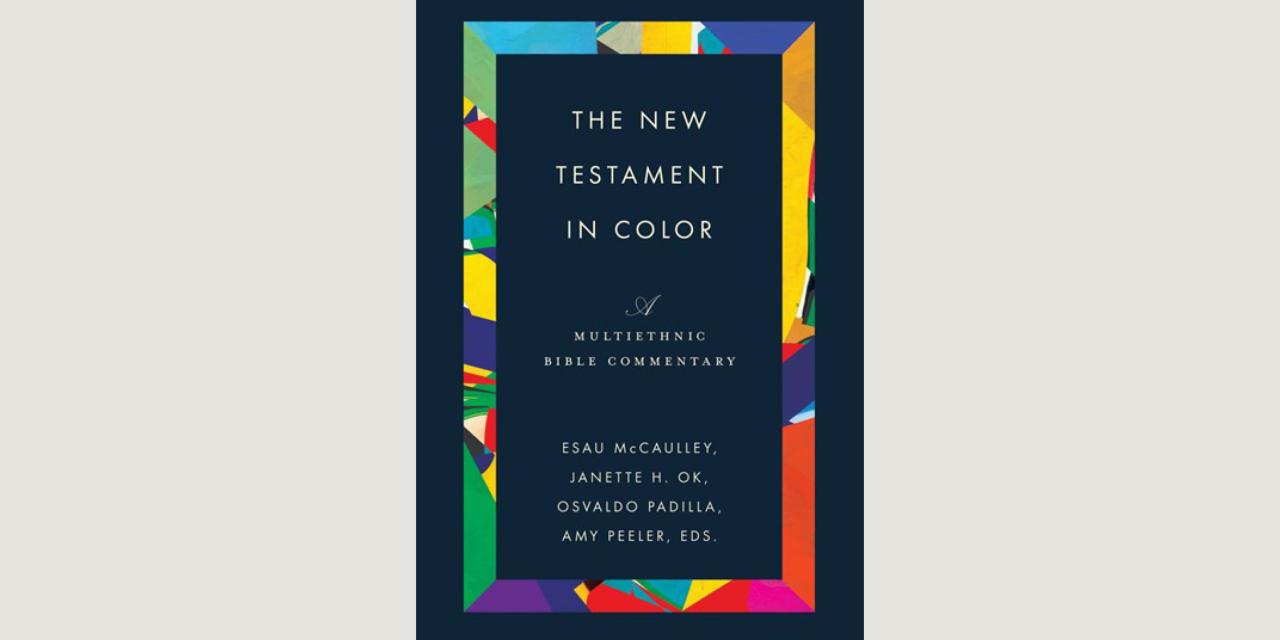
These are some of the insights of the twenty-six New Testament scholars, mostly evangelicals and people of color, who wrote The New Testament in Color: A Multiethnic Bible Commentary (IVP Academic, 2024). The single-volume commentary models how North American Christians can hear God through others’ voices, bring their whole selves to biblical interpretation, learn and question their own cultural assumptions, and see that Whiteness is a culture.
Hearing God through others’ voices
In the introduction to The New Testament in Color (NTIC), Esau McCaulley reflects on how biblical scholarship in North America and even the rest of the world is dominated by European and White traditions. McCaulley, who wrote Reading While Black: African American Biblical Interpretation as an Exercise in Hope (IVP Academic, 2020), admits he knew little about Asian American, Latinx, or Indigenous biblical interpretations. This led him to ask: What might emerge if diverse groups worked together on a commentary, and what could he learn beyond the Black/White lens that shaped his Southern upbringing?
He asked New Testament scholars Janette H. Ok (Korean American), Osvaldo Padillo (Dominican American), and Amy Peeler (White) to help edit the commentary. Like McCaulley, all are authors, professors, public theologians, and current or former pastors. They recruited biblical interpreters who understand the New Testament’s historical contexts and have the requisite grammatical, text-critical, and linguistic expertise.
NTIC covers each New Testament book, sometimes grouping epistles together. Each chapter is written by one author who describes their racial, ethnic, and/or gender lens without claiming to represent an entire group. The commentary moves pericope by pericope rather than verse by verse. It includes essays on African American, Asian American, Hispanic, Indigenous, and White biblical interpretation along with topical essays on gender, mental health, multilingualism, and immigration.
“The diversity of voices in the NTIC reflects how the Holy Spirit speaks to us through our particularities of race, ethnicity, languages, gender, socioeconomic status, and cultures,” Janette H. OK said at the 2025 Calvin Symposium on Worship. “Hospitality flows from God’s welcome to all of us. We practice this gospel hospitality by listening to different voices in biblical interpretation and the pulpit. This commentary can help us hear God beyond boundaries.”
Everyone reads scripture from someplace
At that same symposium, Kathy Smith, now CICW’s interim director, asked NTIC panelists for examples of how social location affects biblical interpretation. “In seminary,” she said, “we were taught to set aside our own experiences when interpreting scripture, aiming for a ‘pure’ understanding untouched by bias. But this commentary challenges that idea. It asks us to recognize that all of us—including those shaped by White privilege—read through cultural lenses that shape what we see.”
Amy Peeler shared an example from an Epiphany sermon about Jesus’ presentation at the temple: “The Holy Spirit revealed to Simeon that this baby was the Messiah, and Simeon just took Jesus from his parents. Imagine the gut level fear they might have felt,” Peeler said. “Then I realized that Simeon would’ve given the baby back when he needed breastfeeding. The lectionary in my tradition joins the Luke 2 text with a Hebrews 2 text about how all of humanity fears death. But Christ entered and defeated death for us. I used that as a platform to think about our fear of dying and the fear of losing a child to death or a life that’s not worth living. Afterward, an older woman remarked, ‘Only a mother could have preached that sermon.’”
Panelist Dennis Edwards explained, “We all bring a lens to the Bible. Sometimes we see through that glass darkly, and we need people who look at things differently to help us understand. I don’t speak for all African Americans. But my understanding of how White preachers have misused Scripture to justify slavery helped me write my NTIC chapters on Colossians and Philemon. Biblical interpretation has often been done through the lens of those in power. My social location helps me see where the Bible respects those who are not in power. At the wedding in Cana, the person in charge of the banquet didn’t know where the better wine had come from, but ‘the servants who had drawn the water knew’ (John 2:9).”
Peeler and Ok both mentioned learning from Jordan R. Cruz Ryan’s NTIC chapter on Acts, especially his insight that there’s no direct English translation for the Greek term koinōnia used in Acts. However, the Filipino word bayanihan overlaps with the koinōnia concept of community unity and cooperation. Ryan writes that bayanihan means “being a community” and is expressed by the image of people using bamboo poles to relocate a neighbor’s house. He vividly remembers his mother telling him how his grandparents’ house was moved that way. Other Filipino values about prioritizing group goals and justice, fairness, and concern for all “can be a gift to the broader church,” Ryan writes.
In a SOLA Network podcast episode on NTIC, Aaron Lee talks with Ryan and Daniel K. Eng, who wrote the NTIC chapter on James. Ryan says that he resonated most with the Acts 16 passage on the arrest and jailing of Paul and Silas in Philippi. “Reading from my context, seeing Philippi as a Roman colony makes me think of the postcolonial history of the Philippines and Filipino Americans,” Ryan said. “Because Paul is Jewish, the authorities don’t see him as a true Roman citizen. They’re always suspected for being different, as are we. But God shakes the Philippi prison to its foundations, opens the door, and unfastens the prisoners’ chains. This shows God’s consistent presence with the powerless and concern for freeing prisoners.”
Ok’s NTIC essay on Asian American biblical interpretation describes “an interpretive framework of Asian heritage, migration experience, American culture, and racialization.” She wrote the chapter on 1 Peter, a letter sent primarily to Gentile converts, described by Ok as “the elect who are living as foreigners in the diaspora” (1:1). “Diaspora” refers to those who have voluntarily taken up a new religious and social identity as Christians that put them at odds with the values and practices of the dominant culture. Peter calls believers to live as chosen foreigners among the Gentiles and as family within the household of God (1:3–2:12). However, Ok cautions against Asian Americans seeing themselves as chosen to be the model minority. This “stereotype praises Asian Americans not for who we are, but for who we are not, as it inherently pits Asian Americans against other people of color by comparing us to other racial minorities and valorizing us relative to Whites, who continue to be the standard bearer for mainstream success,” she writes.
Learning and questioning
Osvaldo Padilla wrote the NTIC essay on Hispanic biblical interpretation and the chapter on pastoral letters to Timothy and Titus. He asked symposium listeners to think about their assumptions about who gets to interpret the Bible. What might we all learn from other cultures?
Writing about prayer in the household of God (1 Timothy 2:1–7), Padilla remembers the corruption in his home country, the Dominican Republic. Now an Episcopalian living in the United States, he uses the Book of Common Prayer to ask God for wisdom, care, and peace for the nation. But formerly safe nations can crumble. “My experience as a Hispanic helps me to pray, not only for the country where I now live and [which I] cherish, but ultimately for the kingdom of God,” he writes.
Padilla also points out blind spots in his culture, writing, “The Bible is revered and respected in Latin America, even by those who do not confess Christian faith,” yet strict practices such as never placing a Bible on the floor, always standing for readings, and using only one translation can miss the point. It is not leather, paper, and ink that speak to us, “but God himself, the living Word who meets us as he promised he would,” Padilla writes. “Evangelical Christians in North America . . . must be careful not to make the mistake that many believers in Latin America fall into.”.
The NTIC editors at the symposium all said how much they’d learned from the Turtle Island biblical interpretation essay by T. Christopher Hoklotubbe (Choctaw) and H. Daniel Zacharias (Cree-Anishinaabe). The two write that “the attempt to read the Bible as Creator has made us” is foundational to Indigenous North American interpretation.
“Creator has always been present with us. Creator’s fingerprints are imprinted on our stories, ceremonies, lands, worldviews, and lifeways as Indigenous Peoples,” Hoklotubbe and Zacharias write. “While kinship in the Christian community is basic to ecclesiology, Indigenous worldviews extend kinship to the entire community of creation.”
Zacharias’s chapter on Matthew describes Jesus as an “Indigenous man, connected to the land of his ancestors, shaped by the history of his people, and formed by the sacred texts and religious rituals of his heritage. . . . Like Indigenous elders and storytellers, Matthew was a (re)storyteller,” editing and expanding on the gospel of Mark.
Whiteness is a culture
White preachers and worship planners sometimes drop in a sermon example, piece of art, or song from another culture or ethnicity to add “spice” to what they see as “normal” worship. They don’t necessarily see that their preferences for a certain type of preaching, music, “order,” or education reflect a cultural preference and worldview. When White people refer to others as “diverse,” “ethnic,” or “multiethnic,” they unconsciously assume that Whiteness is the norm.
Michael J. Gorman’s NTIC essay on White biblical interpretation explains that in North America, “White people (especially men) of European descent . . . and their ways of reading and their interpretations have dominated the church—and the academy too.” He calls White Christians to “repentance, humility, unity, and communion (deep friendship).”
That starts with repenting of ignoring minority voices, followed by a humble self-emptying that no longer believes “that I, or we, know all or know best.” Accepting the gift of reading scripture within different cultures builds unity. This leads to deep friendship or communion that “only happens when we go beyond hearing others to receiving others, even as they receive us,” Gorman writes.
Gorman says it’s crucial to “acknowledge that reading from different contexts does not mean—or at least should not mean—a revision of the gospel or a compromise about orthodox Christian belief and practice.” Referencing Rescuing the Gospel from Cowboys: A Native American Expression of the Jesus Way, a book by the late Richard Twiss, Gorman writes that people shaped in and by Western culture wrongly believe they have to protect the Bible from “a kind of imagined ‘Indigenous cultural invasion.’” Their fear rises from the “mistaken notion that standard Western/White American readings of scriptures and expressions of faith are somehow unaffected by White culture and are objectively true. It is a gift for White readers of scripture to be liberated from that dangerous error.”
In her NTIC chapter, Julie Newberry asks how a multiply privileged person like herself can “even begin to interpret a letter such as 2 Corinthians, so focused on cruciform apostleship and the Christocentric (re)interpretation of suffering.” Throughout that letter, Paul compares himself to “super-apostles” who claim better results, “peddle the word of God for profit,” and meet cultural norms for eloquent rhetoric and numbers of conversions.
Paul says that God speaks through Paul’s weakness. Paul refuses to receive funds from the Corinthians and proclaims that Christ is Lord of all, and he commends individuals not for meeting culturally determined norms, but for “their divinely given status in and service of the church,” Newberry writes. Talking about race can raise fears of conflict or losing church members or funds. Yet Newberry asks majority-White churches, “What is the cost when we tacitly tolerate racist, xenophobic, and other patterns of thinking and acting that undermine the integrity of our confession that Jesus Christ is Lord of all?”
Hope for continued diversity
The response to NTIC has raised hope for a second volume. The commentary won a 2024 Foreword INDIES Book of the Year Award Honorable Mention and 2025 Christianity Today Book Award for Biblical Studies. Christian Audio plans to release an audio version of the book in March 2026.
Conference attendees at the 2025 Calvin Symposium on Worship said they appreciated NTIC’s diversity but noted it did not include commentators who express the whole range of gender identity and sexual orientation. NTIC panelists agreed they’d love to have a new volume that addressed gender/sexual viewpoints as well as other ethnic and ability viewpoints. “Instead of focusing primarily on social location,” Padilla said, “why not be even more Christological in another volume? We could begin from the redeemed perspective that God has in fact made different peoples, and Christ died for all races, tribes, tongues, and nations.”
Since then, Peeler says she has used NTIC in her New Testament course at Wheaton College. “My students’ essays on the NTIC reveal levels of self-discovery” she said. “It helps them listen to others who see and reflect God’s goodness from their own particular story. One student wrote, ‘It doesn’t demonstrate on my face, but I have Latina heritage. It’s important to me, but I never knew I could talk about it or that it is beneficial to biblical studies.’ I met with a pastor friend in Oregon who says he sees the NTIC on pastors’ desks, not on their shelves, which is evidence that they are using it.”
Learn More
Buy The New Testament in Color: A Multiethnic Bible Commentary and/or the NTIC audio version.
Listen to or read conversations with NTIC editors or contributors published by the Calvin Institute of Christian Worship, Christianity Today, Common Good, Intervarsity Press, OnScript, and the SOLA Network or on YouTube.
Wondering whether Whiteness is really a culture? Read the essay “The Stubborn Invisibility of Whiteness in Biblical Scholarship,” by Ekaputra Tupamahu, an Indonesian American who wrote the NTIC essay on multilingualism in the New Testament.
Nijay Gupta wrote on his Engaging Scripture Substack, “I can’t tell you how many times seminary students have reached out to me asking for solid scholarship from minoritized scholars; in the past, I have offered a list of disparate sources here and there, but even in some of those cases the scholars were pressured to conform to majority (white male) scholarship standards or expectations. Here in The New Testament in Color, scholars were not just invited to bring into the conversation their identities and cultures, but encouraged to do so.”
Learn more about why English-language Bible versions vary so much.