|
Andrew Wilkes
00:00:03
|
00:00:03
|
We coined the term “justice imagination” so that we could talk about the comprehensive experience of doing the work of liberation and justice with the psalter as our guide. There are clearly moments where the psalmists are heavy on lament, heavy on complaining. My wife, Rev. Dr. Gabby Kudrow-Wilkes, likes to say that lament is a faith claim. Rather than viewing lament as something that is devoid of faith, she often makes the point, and powerfully so, that lament is actually the evidence of faith, because we’re bringing it to God.
|
|
|
Kristen Verhulst
00:00:43
|
00:00:43
|
From the Calvin Institute of Christian Worship, you are listening to Public Worship and the Christian Life, a podcast that amplifies people and stories that share wisdom and wonder about Christian public worship. This season for the podcast, we are dwelling in the psalms, the prayer book and song book of the Bible. Welcome to the podcast.
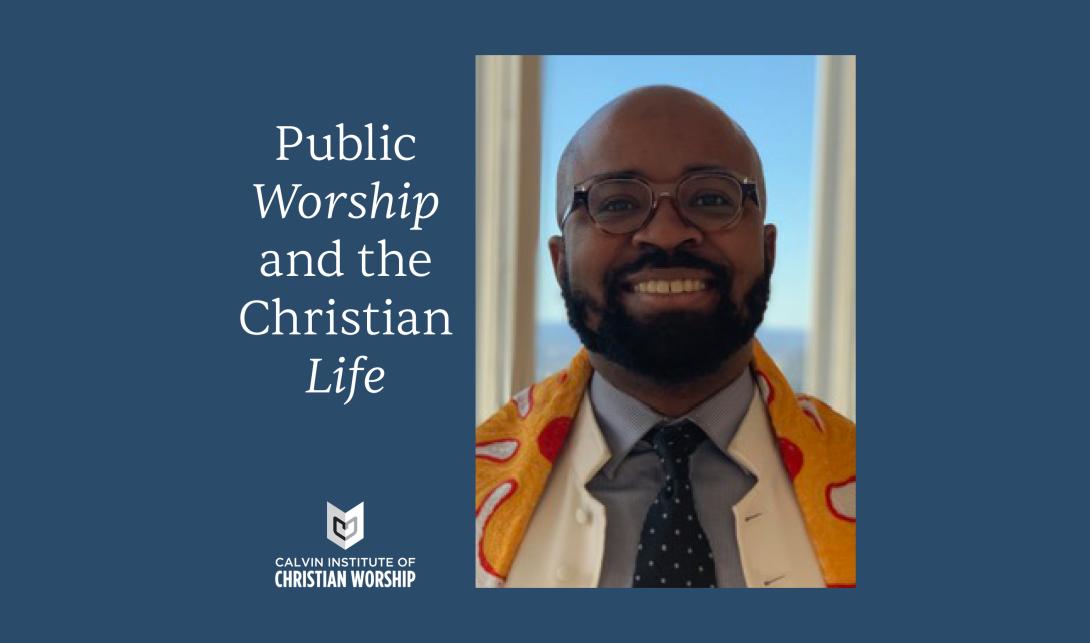
It is a delight to be with you today, Pastor Andrew Wilkes, on the Calvin Institute of Christian Worship’s podcast. Thank you so much for joining me to talk about your book, Psalms for Black Lives: Reflections for the Work of Liberation. Rev. Andrew Wilke is one of the founding and co-lead pastors of the Double Love Experience Church in Brooklyn, New York, and I’m really grateful that you were able to join today. Welcome to you. Would you just give us a little bit more background of your pastoral ministry and lead us into the story behind this book that you cowrote with your wife, who is also a pastor?
|
|
|
Andrew Wilkes
00:02:01
|
00:02:01
|
Absolutely. First, it’s a joy to be with you, Kristin. Thank you so much for the work of the Calvin Institute of Christian Worship. You all are known across the country, across the world, for the work that you do. In just our kind of brief pre-discussion, I was mentioning that I first heard about you all while I was a student at Princeton Seminary, and so it’s a joy to now be conversing with you rather than hearing about the great things that you all are doing. Just a few brief words about myself, and then we’ll talk about the origin story of the book. I’ve had the joy of serving in Christian ministry for the last twenty years and bring to the work of theological reflection being both a pastor and a political scientist. I finished my poli sci degree at the Graduate University of the City of New York, and that work informs my sense that Jesus and justice, that the church and society are inextricably interwoven, in terms of making sure that what we lament about and what we struggle for justice around are connected to our devotional life. And so Psalms for Black Lives emerges from both that space of lament and justice, what we call a “justice imagination” in the book. During the years of the pandemic where New York City was the epicenter, we decided to call a church fast. And in August of I believe it was 2020, we spent about eight days picking a song, pairing it with social action, and literally praying through the psalter. So if you can imagine at a time when we all have on masks, folks are quarantined, we’re thinking about how God is our refuge, a very present help in the time of trouble. And what does it mean to take consecrated collective action to do what we can as collaborators with God in order to relieve the trouble that we face? And so we did that for eight consecutive days. And then out of that ultimately came this devotional.
|
|
|
Kristen Verhulst
00:04:09
|
00:04:09
|
When I came across your devotional, it was in part because this whole academic year at Calvin University and the Worship Institute, we are choosing to dwell in the psalms. And so I was looking around for who could we invite to the podcast that’s done work on the psalms or has stories or experiences around the psalms to share. Could you just tell us a bit more about the worshiping community Double Love Experience, and also, prior to the writing of this book, how you dwell in the psalms in your worshiping community as part of your regular rhythms?
|
|
|
Andrew Wilkes
00:04:49
|
00:04:49
|
Absolutely. So Double Love Experience Church is a church that my wife and I cofounded together based in Bed-Stuy, Brooklyn. It’s based on the double love commandment, Matthew’s version, when Jesus is asked to kind of summarize what this religion business all about. And then Jesus braids together Leviticus, and then takes a little bit of Deuteronomy, and says, “Love the Lord your God with all your heart, mind, soul, and strength; love your neighbor as yourself.” And then in Matthew’s version particularly, Jesus gives a love-powered hermeneutic and says on these two— loving God, loving self and neighbor, hang all the prophets and all the law. And that, for us, is the prism that has fueled our preaching, our teaching, our work of public policy advocacy. We believe that love is both the central motivation and also the destination of the Christian life, and in terms of the psalter itself, that has often been a feature of our shared ministry together. It’s been a source of strength and inspiration for me personally, in terms of dwelling in the psalms—I love that, by the way. I tend to dwell in three different buckets of the psalms. The first bucket is where I began my ministry twenty years ago. The first sermon I ever preached was a sermon called “Bless the Lord: A Theme Song of Thanks,” from the psalm that begins, “Bless the Lord, O my soul, and all that is within me, bless God’s holy name,” bless the Lord and forget not God’s benefits, who redeemed, who crowned you with long life, and so on and so forth. So that's one of those psalms that really epitomize personal and community-wide devotion. The second bucket for me are those psalms that really give language and socioemotional support to the limit experiences of life: grief, anger, death, and the like. And in that bucket, I think—this is me just bearing testimony, Kristen, if that’s all right—so Psalm 88, which starts off as praise, but then concludes, “Trouble surrounds me, and darkness is my only companion.” That’s a rough paraphrase. It definitely ends saying “Darkness is my only companion.” And this notion that we can praise God even while being in the darkness transfigures how we think about praise, but it also transfigures how we can think about darkness, that darkness isn’t something to be afraid of or to stigmatize, but rather the darkness can evoke a mood within which we can give a melancholy magnifying of God. And then the last and final bucket I’ll name are the Hallel Psalms, those last five that start off with “Praise the Lord,” which links praise to specifically calling on God as the one who delivers the oppressed and gives food to all in due season, and that holding together of exalting the Lord with pursuing equity as a seamless core of the life of faith really speaks to me, especially in a time like the one we live in, when those things are often unhelpfully pulled apart.
|
|
|
Kristen Verhulst
00:08:29
|
00:08:29
|
And I appreciated when you talked about that little transition time . . . as all of us read and pray the psalms, we find that movement. . . . Despair, perhaps, but then there’s that moment that says, “And yet God will do this or provide this or support in this way.” And that’s been, I think, a very key part of my own experience of the psalms, is how it opens up room for a wide range of emotions and yet always keeps us anchored to that solid rock that holds us up.
As you mentioned, this really came out of the COVID time period, which now, thankfully, we’ve moved a few years beyond. I wonder, what have you heard from folks that have engaged the devotional? Any feedback or insights that you’ve been hearing from folks who’ve been practicing? You provide basically a month-long approach, thirty devotionals in here to work through. What are you hearing from your readers or folks that have engaged the book?
|
|
|
Andrew Wilkes
00:09:47
|
00:09:47
|
You know, we’ve been really blessed to hear this book take a life of its own. The publisher at Upper Room Books has told us that it sold, this was a few years ago, well over ten thousand copies at this point, maybe many times that. I’ve been thrilled to hear that it’s been a book of study for some congregations. It’s been text folks have moved through for Black History Month, for the Lenten season. But also, during times of both faith crisis and social crisis, it’s been a resource folks have turned to. After a shooting that happened at the Tops grocery store in Buffalo a few years ago, we did a conversation with a pastoral colleague who was leading a church there at the time and also doing some community work, and he had to speak to some students—he was also teaching—and one of the students mentioned there’s a devotional that talks about how connecting with God is our “trauma-free zone.” And she named how that really spoke to the kind of hard-to-disentangle trauma of being in a tough moment where you literally experience an enemy, as the psalter often talks about, and as that community experienced with someone whose firearms literally harmed and injured loved ones. But also being able to, in the crisis of faith, to bring unresolved petitions and to bring the messiness of faith that is challenged on every side to God. And so that’s what the book is really for. The psalter gives us, I think, language, liturgy, and permission to do the heavy emotional labor of connecting with God, even in the difficult times.
|
|
|
Kristen Verhulst
00:11:47
|
00:11:47
|
That leads us very nicely into what I picked up as a key theme about this book, this devotional, and that is helping Christ followers to lean into a justice imagination. Would you unpack that a bit for us? What do you mean by a justice imagination?
|
|
|
Andrew Wilkes
00:12:08
|
00:12:08
|
Thank you so much for your close and considered read of Psalms for Black Lives. It honors us and I’m blessed by it. So justice imagination we talk about in the book as containing four things: First, the capacity to lament, the capacity to envision, the capacity to embolden, thirdly, and then the capacity to celebrate—those four things, envision, embolden, lament, and celebrate. And we coined the term “justice imagination” so that we could talk about the comprehensive experience of doing the work of liberation and justice with the psalter as our guide. There are clearly moments where the psalmists are heavy on lament, heavy on complaining. My wife, Rev. Dr. Gabby Kudrow-Wilkes, likes to say that lament is a faith claim rather than viewing lament as something that is devoid of faith. She often makes the point, and powerfully so, that lament is actually the evidence of faith because we’re bringing it to God. But then the celebration component, the psalmists often mentioned that God is the one who delivered us from slavery in Egypt, that God is the one who can bring us back together from exile. There’s something about celebrating that sometimes we miss in the work of protest and in the work of justice, but holding together envisioning and celebration, being emboldened, as well as lament, I think helps us to be spiritually formed and to have our faith developed in a way that ascends to God, even as the sometimes appropriately agitational work of justice also takes place.
|
|
|
Kristen Verhulst
00:14:04
|
00:14:04
|
Thank you. I was thinking we’re based here at a university, so a lot of 18- to 22-year-olds, who I feel are very much bent toward wanting to do justice-type work, as they consider their studies now, as they consider a career. When you think about perhaps even your own congregation, what kinds of practices do you think will help these young people, have perhaps helped the folks in your congregation really lean into the justice imagination, and help prepare us for the heavy work that it requires, seeking justice?
|
|
|
Andrew Wilkes
00:14:48
|
00:14:48
|
That's a really great question. I’d say a couple of things. One is that we provide some resources in the tail end of Psalms for Black Lives that really speak to the four rhythms of justice imagination. The work of volunteering and direct service is the first one. The work of community development is the second one. The work public policy advocacy is the third. And then the fourth, the work of regional planning, so zoning, and figuring out what kinds of land use and air rights might happen in a given community. I lift that up because our congregation has engaged at varying points in each of those things, particularly the direct service, policy advocacy, and weighing in on opportunities to say how a city or a community should be planned, which enables more medium-term and long-term work to take place. But what I would say to students in that 18- to 22-year-old bucket is first to lean into the probing and the questioning and the studying moments of faith, not as something to be ashamed of or to suppress, but as something that you can invite God into. Those “Why is my soul downcast?” moments, those “Why do the wicked prosper?” moments, are kind of built into the work of justice. And so bringing our questions to God instead of letting them stew on the inside and corrode would be the first thing I’d say. On the more practical piece to what you said, I think a great place to begin is to identify who elected officials and appointed officials are on issues that you care about, and make sure that local agencies and legislative committees are doing what you think they are on issues of mental health, on issues of environmental justice, on issues of making sure that pluralism is upheld. There are many different types of ways that folks embody their faith, that folks of other faith traditions exist in the public square. And being able to match our passion with public policy priorities is a very tangible way that we’ve gone about making sure that hospitals receive sufficient investment from the state. It’s a way we've going about making that New York State can start a reparations commission, where we’ve done some contacting of our lawmakers around. I say that, Kristen, to say, there’s often the sense that one has to change the world by yourself. But in fact, if we work together with those who are also trying to change the world and have a healthy division of labor, that keeps things more sustainable.
|
|
|
Kristen Verhulst
00:18:07
|
00:18:07
|
This made me think, too, of a key theme in our work here at the Worship Institute the last several years, and that is trauma-informed worship practices. And I think the psalms just bring us, give us the language, but help us remember, though, that we have to actually name these things and work together as a community, recognizing there’s inequalities—and this maybe circles us back to your title, Psalms for Black Lives. And here I am a White woman talking to you, a Black man, but we are both in this justice work together.
|
|
|
Andrew Wilkes
00:18:46
|
00:18:46
|
Absolutely.
|
|
|
Kristen Verhulst
00:18:47
|
00:18:47
|
Maybe just talk a little bit about how this book is not just for Black people to read, although I certainly hope that there is a deep, deep connection here. Help me bring in people to this book who might not see it’s for them.
|
|
|
Andrew Wilkes
00:19:02
|
00:19:02
|
What I’d say very simply is that I think particularity is the path to universality without removing particularity. If we think about Christianity itself, this is a faith tradition whose text emerged from a Jewish faith tradition. And it is precisely through that vector and retaining its heritage and appreciation for our Jewish siblings that we have a faith that then spreads its wings to Gentiles, to folks who are being grafted into the faith, to use Paul’s language. And in the same way, I think the riches of Black social Christianity are a gift and holding together this lament, celebration, emboldening, and envisioning that I think speaks to White folks, speaks to Latinx folks, speaks to Indigenous communities precisely through the spacious, roomy imaginations of Blackness. And in the same way, I would imagine that Calvin draws in part its inspiration from Brother John Calvin. And I can think of having read the Institutes of Christian Worship when I was at Princeton Seminary and hearing him talk about scripture as literally a set of spectacles that one puts on. That has been an image that speaks to me, even though I’m from a totally different social historical context than Calvin. It’s in the particularities of what he talks about that I get a portable image. And so it's my hope that folks might connect in that way as well.
|
|
|
Kristen Verhulst
00:20:39
|
00:20:39
|
That’s beautiful. I love that particularity. As our time here draws to a close, what closing words might you have that invites all of us to this holy, demanding work of pursuing justice, of dwelling in the psalms together, working to build a community of believers that truly values Black lives and sees worth in our togetherness?
|
|
|
Andrew Wilkes
00:21:08
|
00:21:08
|
Yeah, I appreciate that question. You know, I’ve been thinking a lot about the Rev. Jesse Louis Jackson, who passed at the age of 84 recently. And he was known for preaching the gospel in the public square. And one of his most famous phrases was “Keep hope alive.” And what I would say to folks inspired by Rev. Jackson’s life, but also and more deeply by the psalms, is to keep hope alive. And the question might then be, how do we keep hope alive, particularly in difficult social moments, polarized political moments, and moments where the church seems to be bickering and beleaguered by just root and branch disagreements? I think the psalter gives us the language for having what I think of as a rough-hewn hope that can help us know that even in the midst of hard moments—oh, I feel good and churchy right here, Kristen!—that God is our dwelling place throughout all generations, from everlasting to everlasting God is there for us; that God is the one of whom we can say “The earth is the Lord’s, and the fullness thereof.” But I want to give one parting word that I think helps us to keep hope alive from one of my favorite psalms [127], which says, Unless the Lord builds the house, unless the Lord guards the city, those that guard it do so in vain. Why do you wake up early in the morning and go to bed late at night eating the bread of anxious toil? And then verse two of that psalm ends: For the Lord loves to give sleep to God’s beloved. Go to sleep, keep hope alive by reading the psalms, and we can do the work of worship and justice with God and our scriptures at the center.
|
|
|
Kristen Verhulst
00:23:14
|
00:23:14
|
Amen. Thank you, Pastor Andrew Wilkes. This has been a really delightful conversation, and I’m deeply grateful for this book, Psalms for Black Lives, and I really enjoyed this conversation with you. So thanks so much.
|
|
|
Andrew Wilkes
00:23:29
|
00:23:29
|
Thank you so much, Kristen; it’s been a joy.
|