Ryan Turnbull is the diocesan discipleship developer for the Anglican Diocese of Rupert’s Land in Southern Manitoba and Northwestern Ontario. He is also a visiting fellow at St John’s College, a theology hub in Winnipeg, Manitoba. St John’s prepares people for ordained and lay leadership in the Anglican Church of Canada. Turnbull led a 2024 Vital Worship, Vital Preaching Grant from the Calvin Institute of Christian Worship. In this edited conversation, he talks about how a poetic imagination can yield new biblical insights and build bridges across groups.
What do you mean by the phrase “Anglican poetics”?
Unlike many Christian traditions, Anglicans don’t have a founding theologian. But we do have a tradition of Anglican poet-priests, from John Donne and George Herbert to contemporary poets like Rowan Williams and Malcolm Guite. And then there are poets who aren’t priests, like Christina Rosetti, Mary Oliver, and Sally Ito. The beautiful, poetic words of the Book of Common Prayer—and especially the psalms—shape how Anglicans pray and what we believe. This way of using poetry to express faith has inspired Anglicans for generations.
Why did you want to do a grant project on Anglican poetics?
Our prayer book tradition holds together the older Book of Common Prayer (BCP) and its various post-Vatican II versions. It also includes the Book of Alternative Services, which emphasizes contemporary language and is adapted to the three-year Revised Common Lectionary cycle. I wondered if there were a way to reconnect with what’s beautiful, holy, and true in the poetic language of the BCP. Our diocese has sixty-five parishes and three missions. It includes inner-city missions, Indigenous ministries, and both rural and urban churches. In my travels around our diocese, I’ve met a surprising number of poets.
When I asked parishes what they wanted to learn about, many said they were interested in Anglican poetry and liturgy. That made me dream about how to reach disciples through a variety of classes, lectures, workshops, retreats, and conferences.
What were your goals, and how did your project reach them?
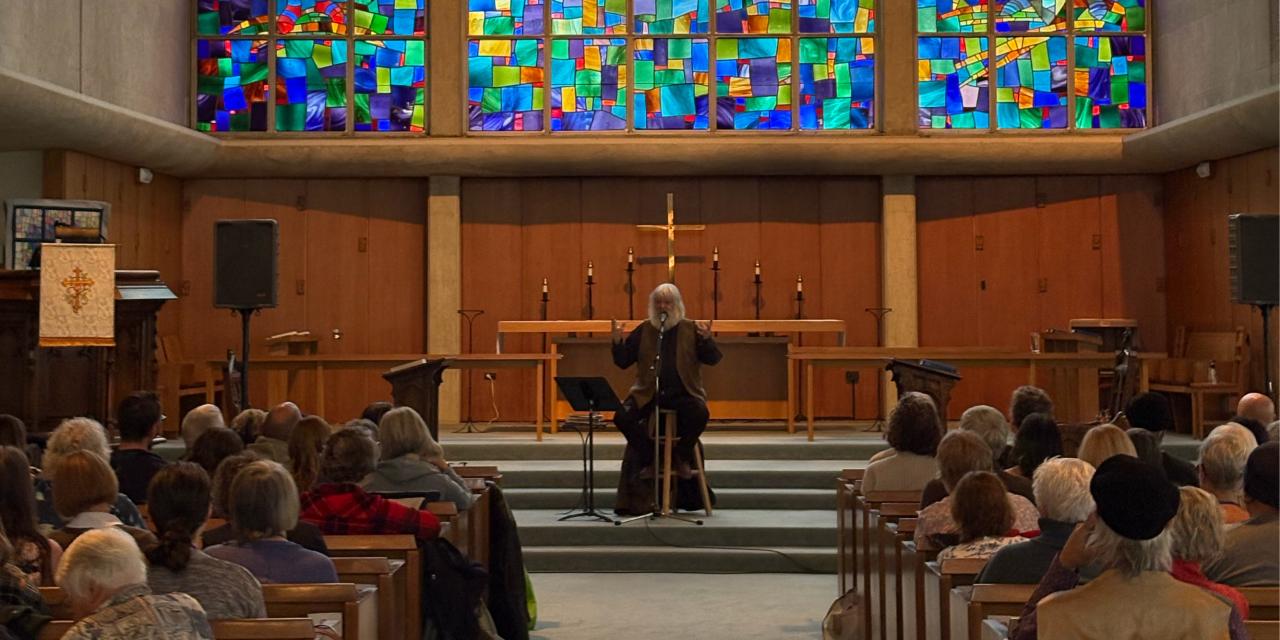
Our first goal was to reintroduce people to Anglican poetic resources. So, at St John’s College, we hosted a class on John Donne and the Bible. One person took it for credit. The rest of the class of about a dozen people audited it. We also hosted lectures on Anglican poetics across the diocese. Our best-attended event drew ninety people to a one-day conference with Malcolm Guite, who is an Anglican priest, poet, and singer-songwriter from England. People came from as far away as Alberta and the United States. One priest told me, “I’m not interested in poetry, but I came to this conference anyway. This is way more interesting than I thought it would be!”
Our second goal was to help people engage with language in hands-on ways. We did smaller events in individual Black, Indigenous, and White parishes on how to write poetry and how to read scripture well in public. Our diocese doesn’t have a formal training process for lay readers at this time. Individual parishes inform the diocese about who they have trained as lay readers, and the bishop issues the license. We found that those already interested in reading scripture well in public really engaged with our grant events. It affirmed my hope that if we tried to create something beautiful, people would come. Many Anglican worship leaders hunger to invite people into the beauty of holiness.
And your final goal?
Anglican poetics offers a generous spaciousness to connect with people who aren’t Anglican. Maryam Rezayi and I planned an afternoon event called “Receiving Roses Across Traditions.” She is a Sufi theology expert and a St John’s College colleague. The event drew people from many or no faith traditions to share gifts of poetry, practices, and food.
We collaborated with the Winnipeg Poetry Slam team and the Centre for Creative Writing and Oral Culture at the University of Manitoba to host slam poetry workshops and an open mic event. And we did two retreats. One was a women’s retreat focused on silence, reflection, and mindfulness. The other invited young adults to study Boethius, an ancient Christian poet-philosopher, and engage with life’s big questions.
Does appreciating Anglican poetics require a certain education level?
We need poetry to access truth slantwise that cannot be accessed any other way. Poetry opens up space precisely where silence and speech collide. Some grant participants had only finished high school. Others had graduate and postgraduate degrees. We found that all kinds of people came just to try to learn more about poetry and how to write a poem.
They explored how metaphors are figures of speech that can contain more than one literal or symbolic meaning. This allows more than one interpretation. Scripture contains abundant metaphors for baptism as a sacrament. This means that different communities can draw on different parts of that symbolism for different purposes at different times. Baptism is often described as washing us clean. But I’ve heard Archdeacon Travis Enright say that can be problematic for Indigenous people forced into church-run residential schools. Some students experienced baptism as saying that they were dirty and needed to be washed clean of their native culture. So thinking of baptism as healing water that establishes kinship with Creator, each other, and all creation might resonate more in Indigenous communities.
How did you involve different generations in your grant?
 Our women’s retreat drew people from ages 22 to 85. Our Boethius retreat was aimed at people in their 20s, yet we also included mentors of middle age and older. I intentionally chose younger people as artists, workshop leaders, and poetry experts. Where possible, we chose younger or mid-career academics to give lectures.
The best grant dollar you can spend is to give a 20-something money to do something interesting. Seika Dyck designed our Anglican Poetics Project logo. It depicts a church roof to show the grant was under the auspices of the church. But there’s a lot of space at the bottom to show our intention to engage with other traditions, poets, and so on. She also made stamps for each parish and created a passport (like the Camino Pilgrim Passport) so participants could log the events they attended. Graduate student Cole Osiowy made the physical run of the December 2025 Rupert’s Land News issue, which included poetry created during our grant project.
Did anything especially surprise you about your project?
I was surprised by how many non-Anglicans came to our events. For example, only a handful of people at the poetry slams were recognizably church people. There’s a big Islamic society at the University of Manitoba, and many Muslims came to “Receiving Roses Across Traditions.” Indigenous poet Samantha Martin-Bird attracted a variety of participants to her workshop on chiasmus in scripture and poetry. So many people from outside the church engaged with us. Our poetry projects were like a nonthreatening form of witness.
Our poetry projects were like a nonthreatening form of witness.
I was surprised how little resistance there was for other organizations to partner with us. I think people thought that poetry is sort of spiritual and existential, so it makes sense that a church would offer poetry events.
What changes did you see in people or parishes because of your grant?
One grant participant is a writer who didn’t consider himself a poet. He was inspired to join a poetry writing group. Some students are now pursuing arts careers because of opportunities our grant gave them. One student decided to reengage with college chaplains and now goes to morning prayer.
Parishes already interested in language and Anglican poetics are even more intensely involved in exploring imaginative use of language in worship and public scripture reading. At a recent meeting of the Canadian Theological Society, I moderated a panel of scholars who continue to think about Anglican poetics.
Did your own learning through the grant project affect your preaching?
Reengaging with Anglican poetry connected me with older ways to read the Bible. We can look for figurative language, typology, and metaphor (such as “living water”) to notice patterns of redemptive history. These patterns help us see how the New Testament reads the Old Testament. English Anglican writers like C. S. Lewis, Charles Williams, and J. R. R. Tolkien (Anglo-Catholic) used myth, Arthurian legends, and protohistory that resonate with the Bible. This has made me more open to including more metaphors and juxtaposition in my preaching.
For a Lenten sermon, I looked for how that Sunday’s four lectionary readings cohered around Christ. The daily readings for that week included 1 Corinthians 10:1–4, where Paul refers to Christ as the spiritual rock that Moses hit in Exodus 17 to bring forth water. In Hebrew tradition, the rock that Moses hit followed the Israelites around through the desert. It’s like literary time, where texts can reference each other across different historical periods. It helps us sense how past, present, and future coinhere in Christ.