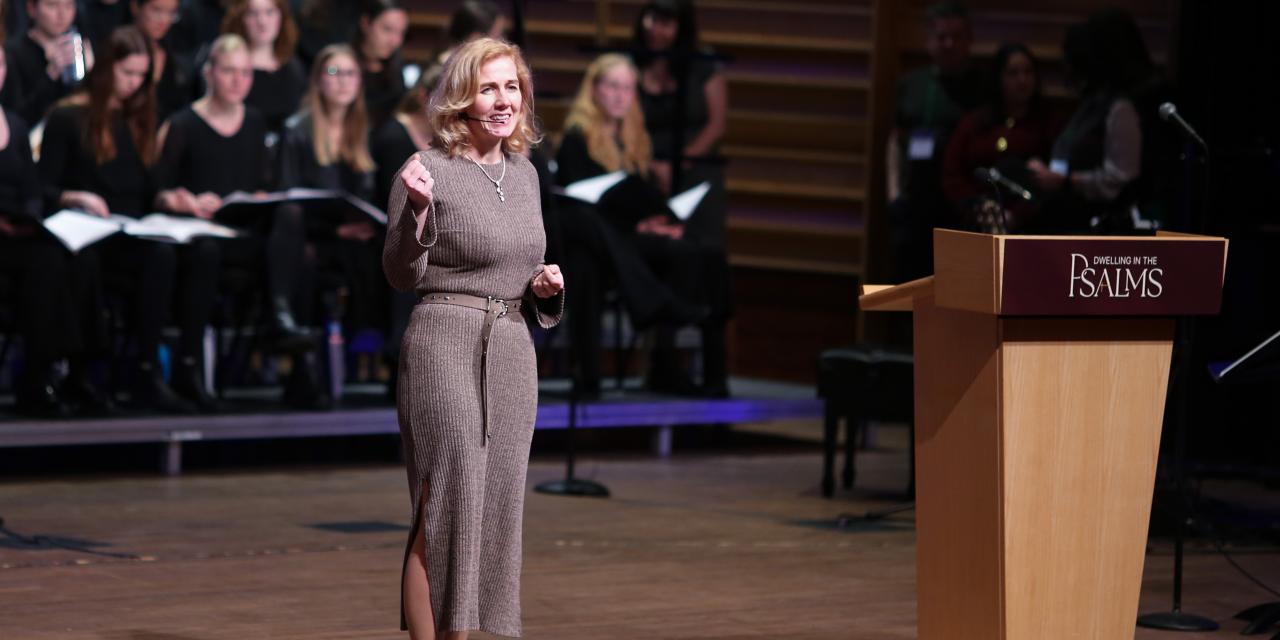
Karen Campbell is a pastor and musician who has served Presbyterian churches in Northern Ireland and a congregation in the United States. She is general secretary of the Irish Council of Churches. David Campbell is a musician and the English department head at Ballyclare Secondary School. The Campbells have written many songs together. In this edited conversation, she discusses the eight songs they wrote for a project called Considering Lament: Psalms of Protest, Pain and Hope.
How did the Considering Lament project come about?
This project grew out of an earlier effort by the Presbyterian Church in Ireland (PCI) to honestly look at its own history during the Troubles in Northern Ireland. Historians don’t agree on whether the violent conflict started in the late 1960s or on the 1972 Bloody Sunday. But this period lasted until the 1998 Good Friday Agreement. And trauma still lingers.
In 2019, PCI published a book called Considering Grace: Presbyterians and the Troubles. It was based on geographical focus groups and collected stories from 120 Presbyterians about how they coped with loss and tests of faith during the Troubles. That book broke open many questions, such as “Could the PCI have spoken up more? Could it have done more to make peace?”
Considering Grace led to the Considering Lament project. Rev. Dr. Tony Davidson is a retired pastor and chair of the PCI Peace and Reconciliation Panel. He asked David and me to reconvene the eight regional focus groups and do Bible studies, with each group studying one lament psalm. From these studies, we created a set of eight psalm-based songs and prayers to help worshipers express grief, anger, and hope.
Are the Troubles still fresh in many people’s minds?
Oh, yes. The peace agreement was signed over twenty-five years ago, and weapons have slowly been handed over. But the wounds haven’t fully healed. In fact, there are now more peace walls in Belfast—walls built to separate Protestant and Catholic neighborhoods—than there were before the peace agreement. And so “lament” is a verb. “Lament” is an ongoing verb. We will never stop lamenting. But in lamenting, we cry hope.
What was your process for creating the lament psalms?
We returned to the same Considering Grace focus groups across Northern Ireland. Our groups were a mix of old and new participants. Each included a voice from the Catholic community and a young person who grew up after but in the shadows of the Troubles. David and I studied lament psalms together and chose a psalm that matched what people had experienced in each area.
I met with one focus group each in Armagh, Ballymena, Bangor, Belfast, Derry/Londonderry, Dungannon, and two in Omagh. Each group studied “their” psalm and shaped its words to their stories. Then David and I used their words to write songs and prayers. It was important that this project was victim centered in every way. Each group reviewed the songs and prayers and had the final say over the words. Local artists recorded the songs in a studio in South Armagh. The recordings were mixed and finished in Bath, England.
What insights did group participants share?
In each group, the goal was to help people move from being stuck in their pain to complaining, to questioning God, to finally praying. I’d ask, “How do you want to pray today? What do you want to say to God?”
Sometimes, if the group was ready, I asked, “What does reconciliation sound like to you?” For one woman, it was the sound of birdsong. The sight of birds had been traumatic because of their presence in the aftermath of a bomb. But now she sees birdsong as a way to transform pain. So in our “Psalm 5 Ballymena,” the “Listen, Listen” chorus echoes the sound of birds.
In another group, a Roman Catholic woman who had spent years working for peace said, “I’ve never been able to share my own pain in these circles. And I’ve never been this close to the pain of the other side.” This shows how voicing lament can change whom we see as an enemy.
Can you share a story or two of how a lament song expresses the trauma of a specific community?
I grew up in Lurgan, County Armagh, one of the many “murder triangles.” Barricades closed down our town each night to prevent street riots between Protestants and Catholics. British soldiers often searched our belongings when we entered shops. Lurgan was bombed twice in my childhood. We lived a mile away from the truck bomb that exploded in 1992. People heard it from twenty-five miles away, and I can still feel it in my body. The Armagh group worked with Psalm 64, the ambush psalm. In “Psalm 64 Armagh,” lines like “Hide me from conspiracy; their perfect ambush words were a snare to me” came directly from what the group described.
David grew up on the East Coast in Bangor, which was further removed from where much of the violence was located. Yet people and churches mostly stayed silent about violence in Bangor. Focus group members said they didn’t want to give oxygen to wickedness. They saw silence as a way to stay safe. However, they realized that being silent when others suffer can create ambiguity and cause harm. The Bangor group connected with Psalm 39’s language of silence, frustration, and anguish. Our “Psalm 39 Bangor” uses several long notes held in tension to convey the fear and grief of silence. It recognizes the limitations of life and asks for a truer perspective and fresh hope in God.
Will you share one more story?
Protestants and Catholics caused thousands of bombings, shootings, injuries, and deaths during the Troubles. Many perpetrators remained unknown, and many known perpetrators walked free. Our two focus groups in Omagh spoke about the 1987 Remembrance Day bombing, which instantly killed six members of Enniskillen Presbyterian Church. They also bore pain from the Omagh bombing that happened four months after the 1998 Good Friday Agreement. People from these towns still carry open wounds connected to feelings of injustice.
So we based “Psalm 82 Omagh” [about the Remembrance Day bombing] and “Psalm 140 Omagh” on two classic imprecatory laments. The first song asks, “How long will you stand by while the neighbors are fleeing by night? How long will evil ones hide their wrong deed in broadest daylight?” And it asks God to rise up and judge the world. The second song begins with “Evil words swirl all around us, stinging venom leaves its bite. Poison planted in their hearts now seems to dull Your words of light. You’re our God, we long to praise you, truth and justice in Your hands.”
What’s an example of how feedback changed a song?
Psalm 109 connected with the group in Dungannon because it speaks of betrayal, hatred, and desire to see the enemy punished. When I presented “Psalm 109 Dungannon,” the group stopped me and said, “Karen, see that first line? Rewrite it.” I had started with the words, “My God whom I praise, you have been silent.” And they said, “Well, Karen, we just can’t get to praise yet. We need to start with the lament. You’re trying to fix us too quickly.” So the first line changed and became “Why should I praise? Have you been silent?” And my learning was that it made me more honest.
How did writing these lament songs affect you and David?
We heard things we wish we hadn’t. We’ll need some time to heal. Still, it was an honor to be with people as they shared stories of hurt and pain yet looked at their suffering through the lens of scripture. Being honest with God is a first step on a gospel pilgrimage that helps us see our enemies as friends. When we decouple national identity from our religion, we can see each other as followers of the Lamb who was slain.
Being honest with God is a first step on a gospel pilgrimage that helps us see our enemies as friends.
Psalms of lament are rarely sung within our worship services. Writing lament songs made us wonder: If we’d prayed and sung these psalms during the Troubles, would it have saved lives? Would it have prevented the empty chair at the table?
How easy will it be for churches to use these lament songs in worship?
Using these lament songs in worship may be easier musically than emotionally. Musically, Irish Presbyterians have a long tradition of singing psalms. We love psalms like Psalm 84, Psalm 123, and Psalm 124—“If the Lord had not been on our side when people attacked us, they would have swallowed us alive.” David and I composed songs of different lengths and styles, and they can be led by organ, piano, guitar, or a band.
Emotionally, it will be new for churches to sing songs that not only praise God but also cry out to God when life is hard. In my work with the Irish Council of Churches, I’ve seen that the Troubles and their aftermath are still not talked about in many churches in Ireland.
How do you hope these lament songs will be used in worship?
They can fit many worship themes and occasions. For example, “Psalm 7 Derry/Londonderry” asks God to “rise” and intervene. The opening chorus could be used as part of prayers of intercessions. It could also be used to intercede for churches facing persecution in countries where Christians lack religious freedom. Finally, it is an opportunity to name the injustices locally where people have suffered and have waited many long years to see just outcomes. “Psalm 59 Belfast” is another good one to sing on behalf of Christians under extreme persecution.
We hope that church musicians, singers, organists, and music directors will download the sheet music and use it to enrich church worship. Recovering the practice of lament gives space in our worship for marginalized voices to speak their pain to God. This helps them reconnect with and hope in the God who is ever compassionate and loving.
But where it will go, how it will land . . . I don’t know. Still, like caged birds, these songs have been set free to hover over where there has been pain and trauma from the past and offer God’s healing.