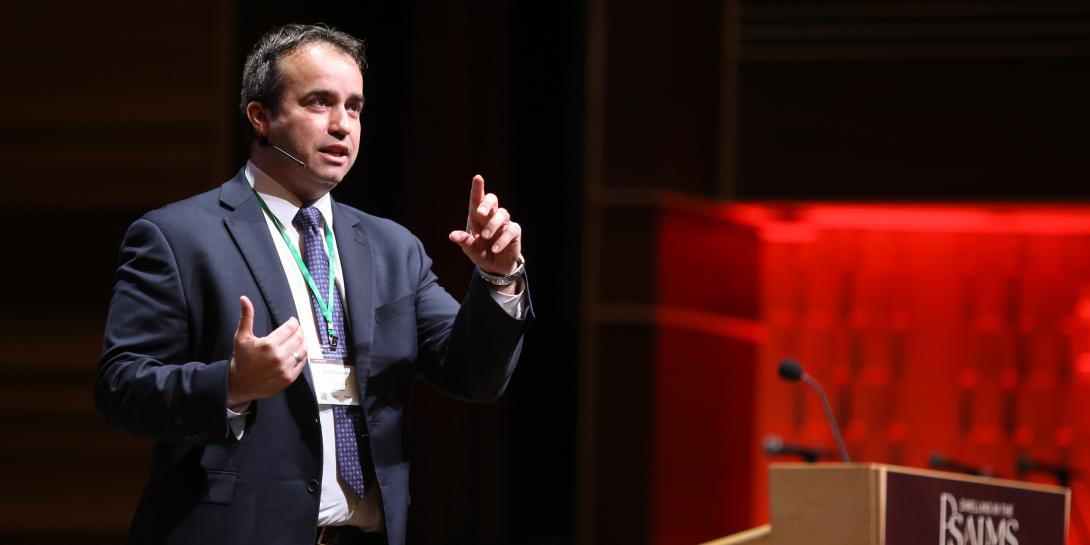
Here he explains why he started using it and why composer Roy Hopp set it to music.
God go before you to lead you, God go behind you to protect you, God go beneath you to support you, God go beside you to befriend you. Do not be afraid. May the blessing of God the Father, Son, and Holy Spirit be upon you. Do not be afraid.
Go in peace to love and serve the Lord. Amen.
When and why did you start ending worship with this blessing?
In about 2004, Scott Hoezee and I were visiting Candler School of Theology, Emory University, for the installation of Tom Long as Bandy Professor of Homiletics. At worship, John Claypool used this benediction, and it struck both Scott and me as powerful. We assembled it afterward from memory, and we’ve both used it since. Maybe the central reason it’s powerful is that is surrounds the listener with a sense of God’s presence, and, then, as a consequence, is bold to tell him and her not to fear.
Where did the blessing come from? It sounds Celtic.
Neither of us has been able to find the exact provenance of the blessing behind John Claypool, but there are obvious echoes of the eighth stanza of the Breastplate of St. Patrick (Christ behind me, Christ before me…).
When did you use this parting blessing?
I’ve used it on any occasion that calls for a benediction from me—chapel services, church services, letters to the grieving, even when Facing your Future (summer ministry exploratory program) high school students leave CTS for their ministry excursions.
What power have you hoped this particular benediction will bring to people who hear it? Do you see it as particularly relevant for our era?
It blesses people, as I said, with the enveloping presence of God, the God of Psalm 139. This is the One we cannot escape—and whose inescapability has always prompted the rebellious to want to re-imagine him, or attack him, or even kill him. But believers who find God’s presence benign, encouraging, and deeply encouraging will want to be reminded of God’s presence and settle into it without fear.
How has this blessing been important in your life?
The blessing has been a blessing to me and to most anybody who hears it. So many believers find comfort in it, especially when the words “do not be afraid” are stated and repeated. There’s something angelic about the words, something addressed to the child in us, something comforting in the strong sense of that word.
Whose idea was it for Roy Hopp to set those words to music? How do you hope Roy’s version will be used?
The idea for setting these words to music and commissioning Roy to set them belongs to Emily Brink, a Christian leader and liturgist of stellar sensitivity. The Hopp setting is, to my mind, a triumph—as Roy’s music always is—so fresh, lyrical, and musically intelligent. It has a bracing, spiny treatment of “do not be afraid” the first time and a more comforting treatment in the repetition. It’s masterfully done, and I’d be astonished if it didn’t become well known.