In many North American churches, fewer people are attending worship services, and the median age of those who do attend is rising. Those who remain in small churches often feel discouraged.
First Presbyterian Church in Tonawanda, New York, was organized in 1852. But after the COVID-19 pandemic, average attendance at worship had dwindled to twenty people. “The congregation considered downsizing their ministry or even closing,” pastor Rebecca Chaffee says. “Instead they voted to adopt a growth plan before calling me as the full-time pastor.” She began in January 2023.
“The congregation used to have so many babies that there was an enclosed crying room in the back of the sanctuary. Worship for children and teens happened in other parts of the building. They never learned worship routines like communion or the offering. They hadn’t connected with adults in worship, so most drifted away,” Chaffee says. “I came to First Pres Tonawanda with a special interest in children’s spirituality from my MDiv work and intergenerational ministry from my DMin work.”
Since retiring as a full-time pastor, Ron King often provides pulpit supply in what he calls historic, small, and declining churches. “These churches were founded fifty or more years ago. Their average attendance is under fifty, and average attendee age is over fifty,” he says. “People often express shame that their church is no longer what it was. They report grief, fear, and discouragement about only being able to pay a part-time pastor.
“There’s a humbling in being stripped down and declining from greatness,” King notes, “but these small churches still have their stories and deep relationships. That makes them especially suited to grow through storytelling and narrative worship.” As founder of Sidebar Stories, he recently worked with the American Baptist Churches of New Jersey to help churches reimagine the stories they live by.
Chaffee and King each led a project funded by Vital Worship, Vital Preaching Grants from the Calvin Institute of Christian Worship. Through storytelling, narrative worship, and story maps, they helped small congregations see how Bible stories connect with their own stories. These explorations yielded new relationships and possibilities.
Storytelling across generations
“It’s a challenge to overhaul faith systems based on age-segregated school systems,” Chaffee explains. “The future of faith has got to be people building relationships across generations. Using storytelling in sermons and scripture readings spices up worship. It levels the playing field because a six-year-old and a ninety-year-old can all be on the same page. Including storytelling opens possibilities yet still maintains a traditional worship structure that many older people find comfort in.”
“My sermons are often story-based with a heavy reliance on the type of questions Godly Play is famous for,” she adds. “I’d rather invite the congregation into wonder, reflection, and discovery with me around a story from scripture than tell people what to believe.
“Our grant planning began by asking, ‘How can we tell both God’s stories (scripture) and our stories of faith (testimony)? How can we promote more active participation by all ages in worship through storytelling?’” she says.
The First Pres Tonawanda grant project included book studies, hands-on workshops, and celebratory meals. People joined in person and by Zoom to discuss books such as The Gift of Wonder: Creative Practices for Delighting in God, by Christine Aroney-Sine, and The God of Story: Discovering the Narrative of Scripture Through the Language of Storytelling, by Daniel Schwabauer. Chaffee says that the book studies helped people identify and share their own faith stories. So did an online coaching course and an in-person workshop by Mackenzie Ryan Walters, who wrote Faith Storytellers: Unleash the Power of Your Story.
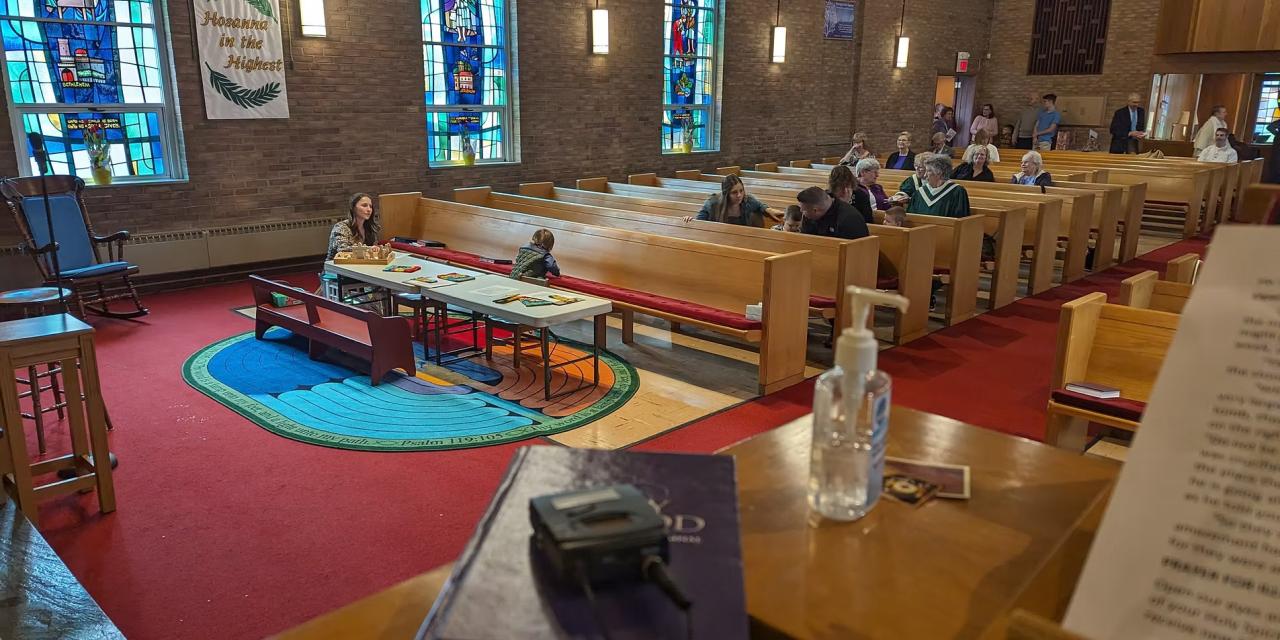
“All ages responded well to Godly Play training and materials to connect with Bible stories more deeply and to wonder about ways the stories connect with our lives,” Chaffee says. “We now have Godly Play story pieces in our small chapel and in our Prayground at the front of the sanctuary.”
Members learned how to act out scripture readings using physical action and simple costumes and props, like blue fabric to represent water. These follow a lectio divina style of “Pretending Bible Stories” or a scripture tableau style of embodying the text.
“We reinforced what we studied by practicing at midweek supper worship, outdoor singalongs, and other events not on Sunday mornings,” Chaffee says. “Whatever we studied or learned, we’d bring back into worship. If you tell the story physically, you never forget the details.”
Narrative worship and story maps
The grant led by Ron King guided five American Baptist congregations in New Jersey through nine months of training and planning in narrative worship. “Narrative worship names a way of paying attention and recognizing how scripture and lived experience speak to one another as stories filled with meaning, movement, and possibility. It brings together what God tells us in the Bible with the story we are living as a congregation,” King explains.
The participating churches were all historic, small, and declining. Pastors and church leaders learned at a March 2025 retreat how to gather stories and testimonies. Each church spent about three months collecting stories of God’s work in their congregations and three months on God’s wisdom to name what the church has learned from God. They also spent three months on how their stories helped them sense God’s will for their future.
Pastors preached three sermons on what the congregation was discovering. Some spread the sermons out; others did them in consecutive weeks. People told testimonies or shared church history during worship and at special meals.
“Every church had really different messages,” King says. “They weren’t focusing on a theory, idea, or theological statement about God’s work, wisdom, and will. Rather, their storytelling helped identify the particular expression in their church over time.” The grant ended with a second retreat for churches to share what they’d learned.
Grant participants learned the “PHD” pattern—Possibility, Hurdle, Discovery—to help them pay attention to stories unfolding in their lives, their congregations, and the Bible. “Familiar patterns often carry their deepest meaning when we slow down enough to notice them,” King says. “You can tell a story with this pattern no matter which element you begin with. When someone tells it back to you, it helps reveal the power and connections in the story’s wholeness.”
In the 1 Samuel 17 account of David and Goliath, King Saul offers the possibility that using his kingdom’s best armor will help a soldier defeat the giant. He promises his daughter’s hand in marriage, immense wealth, and a lifetime tax exemption. The armor was too big for David, but he believed in the possibility that God could help him. The hurdle was how David could kill Goliath without armor or battle experience. As David recalled using a slingshot to save his sheep from bears and lions, he discovered he could trust God to help him again.
Story is one pathway to awe, and awe opens the door to the kind of worship that reshapes how we live.
“When the connections become visible,” King explains, “the story becomes more than memory or explanation. It becomes a place to rest where awe can arise and where worship often follows. Story is one pathway to awe, and awe opens the door to the kind of worship that reshapes how we live. Narrative worship draws the whole self into the whole story until the wonder of it alters how we show up in the world.”
New relationships and possibilities
One participant church collected stories of how they used to have a ministry of feeding unhoused people. Remembering this moved them to start doing it again. In another church, people often mentioned their pastor’s habit of carrying a notebook so he could write down what he heard. They realized their pastor had a gift for writing, so they decided to help him make more time to write. “Noticing his habit of attention became a part of the story they tell about their church,” King says.
“Our grant goal was to do more than have three focused sermons,” King explains. “We want to fold narrative worship and storytelling into our churches’ worship and mindset. This helps them see that worship is not limited to what we call the worship service or order of worship. It’s also an act of worship to go out to coffee with someone and tell your story. Story becomes a bridge between parts of our own soul, between one another, and between the life we are living and the God we seek. It’s like walking along the road with Jesus and someone gets healed. This noticing and telling become part of life. It joyfully roots us in who God is and what God does.”
At First Pres Tonawanda, average attendance has grown to thirty or forty in person plus a dozen more who watch the livestream or interact with the worship video later in the week. People of all ages have become more comfortable sharing prayer requests or wondering questions during worship.
“Storytelling allows us to imagine new horizons that may look very different from the past,” Chaffee explains. “There may not be an influx of members with young children to fill a Sunday school classroom. But children who do attend find immediate welcome into the whole worshiping community. They are invited to ask for prayer requests, sit in the Prayground during service, shake hands to pass the peace, usher, or help take the offering. I see people of all ages talking together after church.”
Besides the congregation’s stories and deep relationships, First Pres Tonawanda also has a centrally located building across from a park. They’ve been inspired to develop a ministry of presence in their small town. They’ve started a free stretch class that includes body prayers and a preschool story hour using God Loves Me storybooks.
First Pres hosts six Alcoholic Anonymous groups, an interdenominational Bible study for moms and kids, suppers, singalongs, and craft nights. People often walk their dogs in the park across the street, so church members give out coffee, dog biscuits, and water and offer prayer at a weekly Paws for Prayer. Because the annual town Christmas parade passes First Pres, they set out a sidewalk propane heater and let people use their bathrooms. And they offer free coffee, cookies, cocoa, and info on their Advent and Christmas services.
“Storytelling has allowed us to see our mission as so much more than the number of registered giving units on Sunday morning,” Chaffee says. “More people now say, ‘That’s my church,’ and some even come on Christmas Eve or Easter.”