Rebecca Chaffee is the pastor of First Presbyterian Church in Tonawanda, New York. She first used her gift for creative organizing and synthesizing in the technology industry. Later she became a Christian educator and then an ordained pastor in the Presbyterian Church (USA). She also served as executive director of the Center for Christian Growth Resources of Western New York. In this edited conversation, Chaffee discusses what happens when church members of all ages learn to tell faith stories and act out Bible stories.
What made you interested in intergenerational storytelling in worship?
When my children were young, I saw what happens in churches where children and youth are routinely dismissed from the sanctuary to go to Sunday school. Young people graduate from age-segregated worship with few to no connections with adults or adult worship. They drift away. I wanted something different for my kids, so I took some classes and became a church director for education and family ministries. I went on to become an ordained pastor and earned a DMin focused on intergenerational ministry.
Research shows that if you want children to retain faith and church involvement, the key isn’t how much money you put into it. What matters is maintaining five or more relationships with adults you’re not related to. That’s according to the book Sticky Faith: Everyday Ideas to Build Lasting Faith in Your Kids, by Kara E. Powell and Chap Clark. Learning to tell faith stories and enact Bible passages in worship helps people of all ages learn from and with each other. It’s a way to spice up worship while maintaining a traditional worship structure that many older people take comfort in.
Please briefly describe your grant.
Our grant project included book studies, hands-on workshops, and celebratory meals. We reinforced what we studied by practicing at midweek supper worship, outdoor singalongs, and other events not on Sunday mornings. Whatever we studied or learned, we’d bring back into worship. We focused on short testimonies, Godly Play, and enacting scripture.
How did your congregation learn to give short testimonies?
We studied a few books together to help us experience awe and wonder as we look for connections between God at work in the Bible and in our lives. Several of us attended an online coaching course with Mackenzie Ryan Walters, who wrote Faith Storytellers: Unleash the Power of Your Story. She helped us identify stories that showed God at work in our lives right now.
We then trained other members how to tell stories with a beginning, middle, and end. We also invited the public to a free event with an afternoon Faith Storytellers Workshop, a community meal, and a Faith Storytelling Night modeled after The Moth radio program.
What counts as storytelling or testimony in your worship services?
Lately some of our favorite moments in worship have become the gathering, passing the peace, and asking for prayer requests. A faith story could be asking prayers for a baseball game. A six-year-old told me his schoolmate had died, and he agreed when I asked, “Would you like to pray about that?” A 72-year-old man with intellectual disabilities lives in a group home. One Sunday he stood up and said, “I don’t know what to do. A friend said I should do something. I don’t want to.” People cheered him on for sharing. We take it all seriously because we believe that God can and does intervene in our lives.
My theology of worship is that worship is the work of the people, not the work of a few leaders in front of the people. We’ve added a segment between the prayers of the people and the offering. We call it “Moment for Faith Story.” Once or twice a month, people prepare short faith stories of three to five minutes to offer as testimony in response to the word.
How has using Godly Play reached across generations at First Presbyterian?
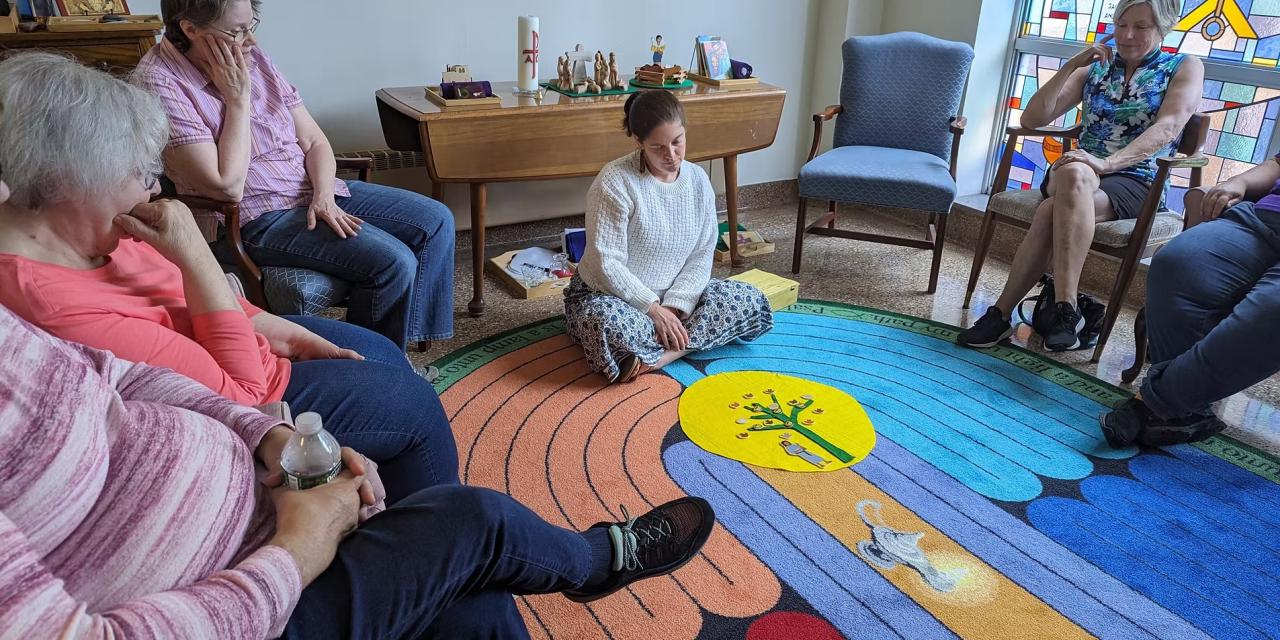
Godly Play is a way of telling Bible stories so any age can make discoveries for themselves. I’d rather invite the congregation into wonder, reflection, and discovery with me around a story from scripture than tell people what to believe. During our grant, we sampled different ways of using the technique thanks to Godly Play trainer Mary Hunter Maxwell and Judson Bridgewater, an Anglican chaplain in the Canadian armed forces. Mary helped us create an all-age chapel space with Godly Play materials. Seven members and one partner became certified in Godly Play Core Stories.
A father and his nine-year-old son learned to tell a Godly Play story together. The man read the Bible passage while the boy performed the actions with Godly Play materials. After hearing another Godly Play story in Sunday school, a six-year-old boy assisted the storyteller in worship. We often move specific Godly Play pieces from our chapel to the Prayground at the front of our sanctuary so that children can interact with the pieces during worship.
Can you suggest other ways to dramatize Bible stories during the scripture reading?
During our grant, we learned to enact scripture through a lectio divina style of “Pretending Bible Stories” or a scripture tableau style of embodying the text. I learned about pretending Bible stories while taking a seminary course from Suzanne Guthrie. Worshipers meditate on scripture as one person reads while others use simple props and costumes to be a tree or rock or boat or hold up blue fabric for water.
I learned about scripture tableaux from the book Children at Worship: Congregations in Bloom, by Caroline S. Fairless. I ask people to come forty minutes before worship, if possible. We read through the story, divide it into six scenes, and choose who will use which costumes and props to play which part.
How does a scripture tableau work during worship?
When it’s time for the Bible reading, I have the congregation close their eyes. I read a few sentences. Meanwhile, the actors arrange themselves in the first scene and freeze. I ring a bell and the congregation opens their eyes. And then it’s rinse and repeat. We keep things simple. For example, in a story of Elijah or Jesus ascending to heaven, we wouldn’t try any Peter Pan moves. Instead, we’d focus on the shocked expressions of the people who watched the ascension.
People first think it’s corny to close their eyes, but they say their imagination activates when they do so. I let all the actors disappear during the final time that eyes are closed. This is so people don’t start clapping as if they just saw a play. Instead I say, “This is the word of the Lord.”
What did you learn through your grant?
This project showed us the central importance of storytelling in the worshiping community. It’s what we do every time we gather and read scripture, sing hymns, recite creeds, and offer prayers. The stories of the Bible combine with the stories of our faith traditions across the generations.
We also discovered that learning to share our personal faith stories has led to deeper collaboration and communication among congregation leaders and members. We’ve learned to ask, “Where is God in this?” when we approach decisions. Any conflicts have seemed easier to navigate when we include this question and storytelling.
Storytelling has also provided better metrics for evaluating church growth, faith formation, and program success within the congregation as opposed to numbers of people or dollars.
This project showed us the central importance of storytelling in the worshiping community. It’s what we do every time we gather and read scripture, sing hymns, recite creeds, and offer prayers.
Do people see scripture differently?
Once you act out a story physically, you never forget it. I think people are sensing more connections between Bible stories and the lives we live now, both as a congregation and individuals. Godly Play teaches you to make do with whatever visuals or simple props are in a box. Texts, especially parables, can have many meanings, and God can guide us to sense what a community needs now.
Sometimes when people pretend Bible stories by acting them out as the scripture is read, their improvisations are a bit different than the words in the Bible. So we talk about that. Then we meditate, pray, ask, and listen for what God wants us to do.
What else has changed in your congregation since completing your grant?
The grant helped us allow more room for people to wonder and question. It invited people of all ages to learn and practice different ways to tell the story of the text that the sermon is based on.
People have become more comfortable in adding their prayer requests or sharing their own wondering questions during interactive worship portions. Since there are not always children present, I do a worship segment called “All God’s Children,” where I tell a Godly Play story or do an interactive question/answer moment with the entire congregation. When children are present, they sometimes participate in these segments as leaders and storytellers, so it can become more of a message from the children than a message for children.
Any other suggestions for further learning?
We found that book studies during the Sunday School hour or over Zoom studies work best for older members who no longer drive in the dark.
Also, our Godly Play trainer, Mary Hunter Maxwell, introduced us to the “Being With” theology and small group work begun by Sam Wells, vicar at St. Martin in the Fields in London. She felt that “Being With” is another way to introduce Godly Play faith-processing techniques to adult participants. Two of us have taken online training, and we’ll be introducing some of these small groups in the coming year.