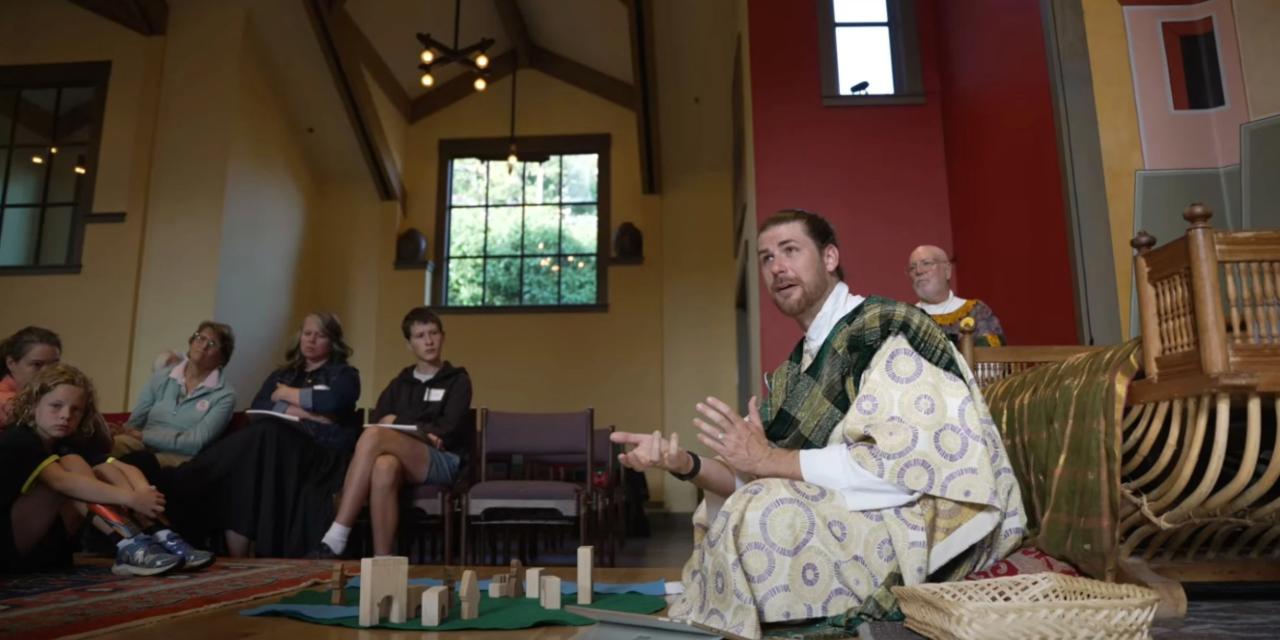
Peter Levenstrong is associate rector at St. Gregory of Nyssa Episcopal Church in San Francisco, California. He has been developing the Living Stories Sermons method as a new preaching method to transform the traditional sermon into a shared act of interpretation. Levenstrong has done so with grants from many sources, including 2024 and 2025 Vital Worship, Vital Preaching grants from the Calvin Institute of Christian Worship. In this edited conversation, he talks about what he’s learned so far about Living Stories Sermons.
What made you want to experiment with replacing traditional sermons with Living Stories Sermons?
Living Stories Sermons began as an accident of the pandemic. Approaching Easter 2021, our congregation was making plans to regather on Pentecost. The kids in our parish were done with Zoom Sunday school and wanted something in person sooner. We started meeting in our back parking lot for a revised version of Godly Play. On a whim, I asked my rector, the Rev. Dr. Paul Fromberg, whether we might also do Eucharist while we were out there. And that's how I fumbled my way through my first Eucharistic services as a newly ordained priest: in a tiny gathering we called “Godly Play & Eucharist.”
When regular services resumed, we carried that liturgy forward for our 8:30 a.m. service, using “Godly Play sermons” for the Liturgy of the Word. (“Godly Play sermons” refers to the cultural phenomenon of adapting Godly Play resources for use in the sermon. It should not be confused with the official Godly Play philosophy or the work of the Godly Play Foundation).
We weren’t the first to do this. Many have experimented with “Godly Play sermons” before, including my predecessor at St. Gregory’s, the Rev. Sylvia Miller-Mutia. But as we kept growing more deeply into the method, two requirements emerged that pushed it into something distinct. First, the reading needed to be the actual translated scripture appointed by the Revised Common Lectionary (RCL). Second, the sermon needed to address the whole worshiping congregation, not just the kids.
How are these sermons like and unlike traditional Anglican sermons or Godly Play?
What sets Living Stories apart from a traditional sermon is structural. Preachers still need to do and offer solid exegesis. But the preacher steps back from being the sole interpreter and instead facilitates the congregation’s own communal interpretation of scripture. The sermon isn’t downloaded from the preacher; it’s co-created in the moment. Doug Pagitt called the dominant model “speaching”—preaching that looks just like a one-way speech. Living Stories is the opposite of that.
But Living Stories still uses the appointed scripture for that Sunday in an approved translation (the Common English Bible). Following the lectionary means being a bit inventive when it comes to figuring out how to enact some stories that don’t lend themselves as easily to this method. It helps a lot to add visual aids for dense passages of monologue. Also, it’s for the whole intergenerational assembly, not children alone.
Compared to Godly Play, the Livings Stories wondering questions are tailored to the specific story rather than using the same set of wondering questions each time. The preacher might ask, for example, “I wonder what Jesus meant when he said . . .” Another difference is that the preacher takes a much more active role in guiding the conversation, mirroring back what participants offer. The role of facilitator is even more important for communal sermon-making than the storytelling is.
How do you choose which stories to tell?
We currently focus on the Gospels, because that’s the reading that comes just before the sermon. However, that choice is about capacity, not principle. The first reading (Old Testament or Acts) can work just as well as the Gospels, if not better, because it’s narrative driven. Even the long speeches usually have a speaker and an audience physically present to enact. The Epistles are the hardest fit because they don’t have stories. They contain the apostles’ written responses to stories, with very little to enact.
I hope that, with more capacity and funding, we’ll eventually offer Old Testament scripts as well. Meanwhile, I’m always excited to hear from preachers who are inspired to go create their own scripts for the Old Testament lections.
What parts of the lectionary are not suitable to this sermon style?
None! Because we’re following the lectionary, we don’t shy away from difficult texts. This is not a children’s sermon. One illuminating example is the beheading of John the Baptist in Matthew and Mark. In years A and B of the lectionary, participants get a special jolt when the John figure has his head removed during the story. (At St. Gregory’s, to prepare my materials in advance, I took a hacksaw to one of our wooden figures. I reattached the head with double-sided tape so it could come off cleanly during the storytelling.)
The sparseness of biblical narrative is actually a blessing here. Living Stories simply enacts what scripture says happened, without piling on extra detail. Hard stories told faithfully, with the opportunity to wrestle openly with them, are part of what trust in Scripture, the assembled community, and the Holy Spirit looks like.
Hard stories told faithfully, with the opportunity to wrestle openly with them, are part of what trust in Scripture, the assembled community, and the Holy Spirit looks like.
Is there an ideal church context for making Living Stories work?
The method is designed for mainline Protestant churches using the RCL, but the underlying values (collaborative, imaginative, subversive, generative) are universal.
Living Stories was born in an intimate worshiping community—our 8:30 service at St. Gregory’s—and that’s where it works most naturally. At around fifty participants, audiovisual technology and breakout groups can be helpful to keep participation flowing. Below fifty, no extra scaffolding is necessary.
That said, the method adapts. In sanctuaries with more than a hundred people, you can use two or three mics with mic runners. You can preserve the facilitator’s role and amplify participation with a hybrid structure. This means people turn to neighbors for one or two of the wondering questions and then come back together. Using cameras and projectors usually doesn’t help much. That’s because looking into each other’s faces is so important during the whole process. We’ve found that using larger storytelling props is almost always a better solution than screens.
How does the architecture of a worship space affect worshipers’ ability to take part?
Living Stories thrives on openness and accessibility. Pews bolted to the floor are a challenge, but not a deal breaker. The bigger issues are accessibility ones, especially hearing. If one elder admits they couldn’t hear, at least ten others were silently wishing the speaker would talk a little bit louder. Three simple remedies go a long way before audiovisual technology is even needed. In large spaces, invite those who want to see or hear better to come closer at the beginning of the story, which can double as a ritualistic opening for the Gospel reading. Mirror back every wondering contribution so every contributor feels valued and all can hear and follow along. And encourage participants to project their voices for the whole room, if they can. Once you’ve done all that, mics and speakers can fill any remaining gaps.
Can you share a story or two from someone under age 18?
At St. Gregory’s, we were reflecting on the Transfiguration and how dark and foreboding it was up there on the mountain when the cloud came down. A four-year-old burst out, “It’s like a dragon is coming!” Instantly we were all transported to the mountaintop with Peter, James, and John. We could viscerally feel their trepidation. The story became much more real to me that day, and I’ll never forget it.
Other preachers have reported similar moments. Several said something like, “This 12-year-old brought up an incredible point and understood that story better than the rest of us.” Children are also the best guardrails against assumed knowledge. A child asking “Who were the Pharisees?” once saved the whole room from glossing over something some of the adults could use a refresher on. Children are almost custom made for wonder.
How is the Living Stories method reaching other churches?
We’ve been spreading the method through conference sessions and our Living Stories Sermons website, webinars, and newsletter. The first congregation outside St. Gregory’s began using Living Stories in August 2024. By August 2025, just one year later, upwards of forty congregations were using it. We now have more than 130 preachers experimenting with Living Stories Sermons in their ministry.
Our 2024 grant included hiring Sarah Bentley Allred, a third-party researcher, to do surveys and group interviews. Our 2025 grant includes working with a bicultural team to produce materials in English and Spanish so more congregations can practice and share collaborative preaching through Living Stories sermons. And I wrote a book: Collaborative Sermons: A Guide to Authentic, Interactive Worship Through Living Stories (Church Publishing, August 2026).
What insights can you share from your network and research?
When asked how deeply the Gospel stays with them after a Living Stories sermon compared to a traditional one, over 50 percent of participants said “more” or “much more.” Fewer than 5 percent said the opposite. Retention of takeaways improved as well. Half said they were more likely to remember something important from the sermon several days later, compared to just 13 percent who said “less likely.” This shows that the tangible, participatory preaching method makes the Gospel become “stickier” for the participants—more than a more traditional preaching method would.
What have you learned about the intergenerational impact of Living Stories?
We had a relatively small sample of minors in the formal research, and many of the qualitative fields from kids were left blank. But the results we did get were striking. Among the seven who responded to the survey, none said they wanted to return exclusively to traditional sermons, two wanted a mix, and five preferred Living Stories outright. Six of seven said the Gospel sticks with them “more” or “much more” with Living Stories, and the same number said they remember an important takeaway several days later.
The written responses from kids were powerful. One wrote, “I start to understand things better, so I can process my emotional reactions better to things from the story.” Another said they appreciated “the feeling of being included.” One articulated something I appreciate deeply: “The freedom of Living Stories is that it doesn't have to be cohesive, and it can contradict itself. This leads to a stronger understanding of the story.” Yet another said that Living Stories “fosters a sense of trust and more community, that the preacher is not above you. They are not teaching you their lessons; they’re wondering along with you.”
What other key insights can you share from the network and book?
Qualitatively, the recurring themes are belonging, surprise, and a sense of authentic engagement with scripture. One participant captured it well: “People truly made an effort to contribute to the discussion, and they did so with confidence and sometimes even urgency. I was aware of the body of Christ being present—being made present—through collective interpretation.” Another from a fundamentalist background said, “For a preacher to ask ‘What do you think?’ in front of everybody is very affirming. ‘Holy’ is a good word for that.”
One of the deepest gifts of Living Stories is that it treats interpretation as a practice the whole congregation participates in, not a service provided by clergy. Many of our participants have spent decades hearing other people interpret scripture for them. They have never once been asked what they think. When we use Living Stories week after week, we watch people rediscover their own theological imagination. One preacher told us that the wonderings opened up their introverted congregation in ways nothing else, including Bible study, had managed. A teenager wrote on the survey, “I like being able to figure it out.” That sentence is, in many ways, the whole project.