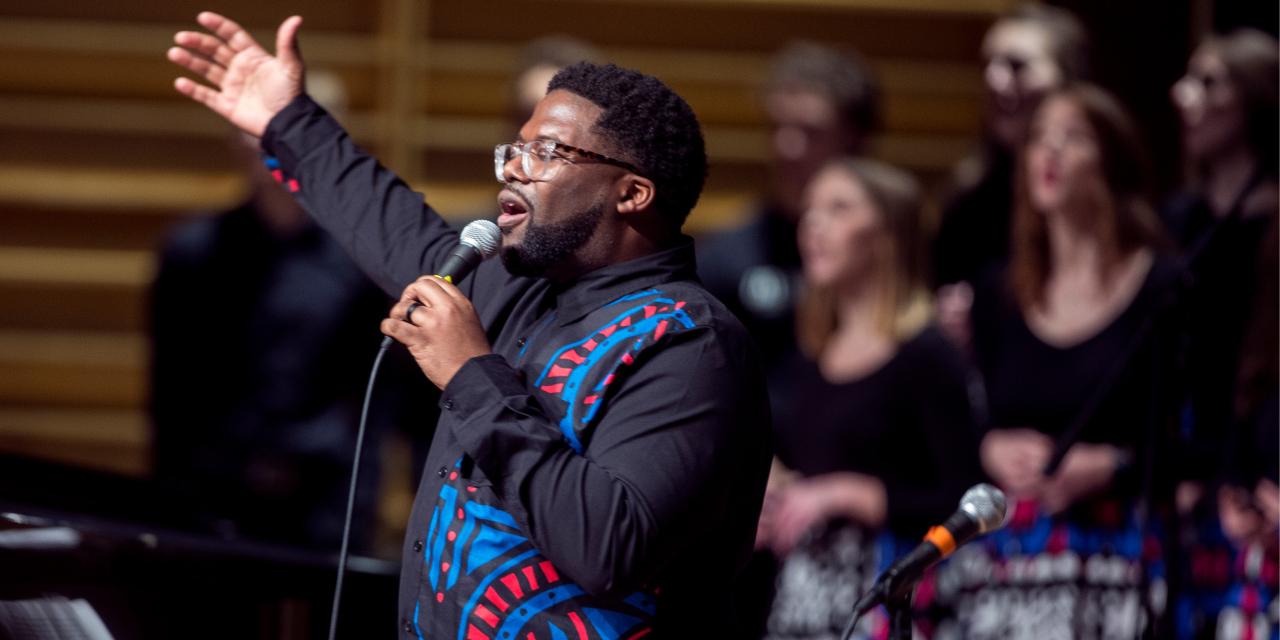
Nathaniel “Nate” Glasper Jr. directs the Calvin University Gospel Choir and serves as a campus worship associate and resource development specialist for the Calvin Institute of Christian Worship in Grand Rapids, Michigan. After twenty years as worship pastor at Grace for the Nations Church, he now serves on its ministry operations team. He also leads national, international, and summer workshops on living a lifestyle of worship. In this edited conversation, Glasper talks about mentoring and directing gospel choirs so that they live a lifestyle of worship.
Who were your mentors in gospel music?
I have been blessed with many mentors throughout my journey. I grew up in a Black Pentecostal church in Muskegon, Michigan, where I began playing piano by ear at age eight under the guidance of Michael Phillips. He taught us young musicians to offer music as worship, not just performance. By my mid-teens, I was already teaching songs to the church choir. My high school music teacher, Joe Lane, inspired me to go after music as a career and not be paralyzed by fear.
In college, I joined the Grand Valley State University Gospel Choir, where Cassonya Carter mentored me, nurtured my potential, and gave me opportunities to lead the choir. She connected me with Dr. Charsie Randolph Sawyer of Calvin University, who invited the GVSU choir to the 2004 Calvin Symposium on Worship. After hearing me lead a song, Charsie felt led to invest in me. She taught me musical fundamentals and helped me bridge my gift with academic training. This led me into roles accompanying the Calvin Gospel Choir and leading chapel services.
And did you find other mentors?
Other mentors who strengthened my calling were Dr. Tim Steele, who chaired the Calvin music department, and Dr. John D. Witvliet, who founded the Calvin Institute of Christian Worship. John encouraged me to pursue a master’s in ministry leadership at Calvin Theological Seminary and invited me to be a part of the CICW staff. This taught me how to host and develop reciprocal learning relationships with scholars, composers, church leaders, and more. Dr. Raymond Wise deepened my understanding of gospel music as a rich, scholarly tradition, and Dr. Tarence E. Lauchié inspired me in church leadership and a life rooted in worship.
What opportunities do you have to mentor Calvin University students?
I not only direct our gospel choir but also have the opportunity work with Calvin’s worship pastor, Paul Ryan, to mentor worship apprentices, support chapel leadership, and assist with discipling students with weekly worship planning. Paul does an excellent job with programming worship opportunities where our diverse community feels included. About two years ago, a group of international students asked for more culturally familiar worship spaces. I collaborated with them to begin the 7:9 Project, a multicultural worship group inspired by Revelation 7:9. They host worship and prayer nights and have conversations about worshiping together as a family.
Gospel choir at Calvin connects classical study with diverse musical traditions. Since Mark Stover joined as director of choral activities, I’ve been inspired by students’ eagerness to learn from different genres. Many gospel choir members also participate in Women’s Chorale and Capella, contributing to a rich and interconnected musical community. This next generation of musicians want more. They enter academic spaces with curiosity, humility, and openness to styles beyond what they already know. Their willingness to explore gospel, classical, contemporary, and global traditions enriches their musicianship and our community.
What do you mean by “a lifestyle of worship”?
This is an approach to life where honoring God is not limited to music, Sunday services, or moments of emotion. Instead it is woven into everyday attitudes, decisions, and relationships. To me, it means worship is not just something we do; it’s the way we live. I like to use Romans 12:1–2 as a reminder to offer my life as a praise to the Lord.
Here is a mantra-like prayer that I say often to my students. It comes from the lyrics to a song by Judith McAllister, called “A Worshiper’s Prayer”: “May the life that I live reflect your glory. May the words that I speak honor your name. May the thoughts that I think be pleasing unto you. May my life be a praise unto you, Lord.”
How do you promote a lifestyle of worship in your student and church choirs?
I try to build a culture where worship isn’t something we start when a rehearsal, chapel service, or concert begins. Instead, a lifestyle of worship is a posture that we bring with us. We begin rehearsals with scripture or reflection to center our purpose. I encourage singers to share testimonies or prayer requests to cultivate community. My goal is to teach the meaning of the music, its history and theology, and the overall emotional landscape. When we internalize that worship is a lifestyle, the music becomes more authentic and spiritually powerful.
Can you share an anecdote that might help other gospel choir directors improve their leadership or expectations?
I remember preparing for a high-energy piece for a Calvin University Gospel Choir concert. I gave technical feedback—on dynamics, timing, vowel shapes—but it wasn’t coming together. During our final rehearsal, I stopped everything and asked, “What are you trying to communicate with this song? What is the message?”
I wanted them to know that we were singing it like a task and not a testimony. That changed everything! Once they connected to the message, not just the notes, the sound transformed. In ten minutes, we cleaned the same musical issues that we’d struggled with for two weeks. Sometimes the issue isn’t musical; it’s spiritual or emotional. When the choir reconnects to the why, the how follows naturally.
How do you make sure your singers don’t strain their voices?
It is very important to me to be sure the students protect their voices. This is essential in gospel choirs, especially if singers aren’t used to emotionally powerful and physically demanding music. Healthy singing allows for both longevity and a consistent, strong sound. We use exercises that gradually expand vocal range and help with the chest to head transitions so common in gospel music.
I emphasize breath support, not throat tension. We rotate high-range or taxing parts, especially for altos and tenors, who tend to oversing. I train singers to listen across the choir so they blend in instead of shouting. It’s also important to choose music with lyrical clarity that singers can sing faithfully. Not every choir is built for the ranges and riffs in contemporary gospel music.
Can gospel music shape how Christians live out their faith in the world?
I will say this: Gospel music shapes Christian living by moving faith from something people believe into something they embody. Worship is not treated as a private, quiet experience, but as a lived, communal public witness. When believers immerse themselves in this cultural experience, they are reminded that faith is not about escaping hardship, but about trusting God inside the hardship. The lyrics call us as believers to love, serve, forgive, endure, and, most of all, testify!
Also, gospel music addresses racism by telling the truth. This music exposes history, suffering, and resilience through song. It forces singers and listeners to confront the realities of injustice, the stories behind the sound, and the cost of hope. This in turn builds empathy, humility, and awareness. I love that this music creates spaces where people from all nations, tribes, and tongues can come together to sing, lament, and celebrate.
What gospel music choir resources can you recommend?
Gospel Music Workshop of America (GMWA) offers training, repertoire, and networking. Readings in African American Church Music and Worship, by the late James Abbington, provides excellent history and context. NTimeMusic.com is a music publishing firm that specializes in gospel sheet music and gospel songbooks. For college choirs, try gospel anthem arrangements by Donald Lawrence, Richard Smallwood, and Kurt Carr. I also recommend YouTube masterclasses from Jason Max Ferdinand, Donald Lawrence, and Trey McLaughlin.