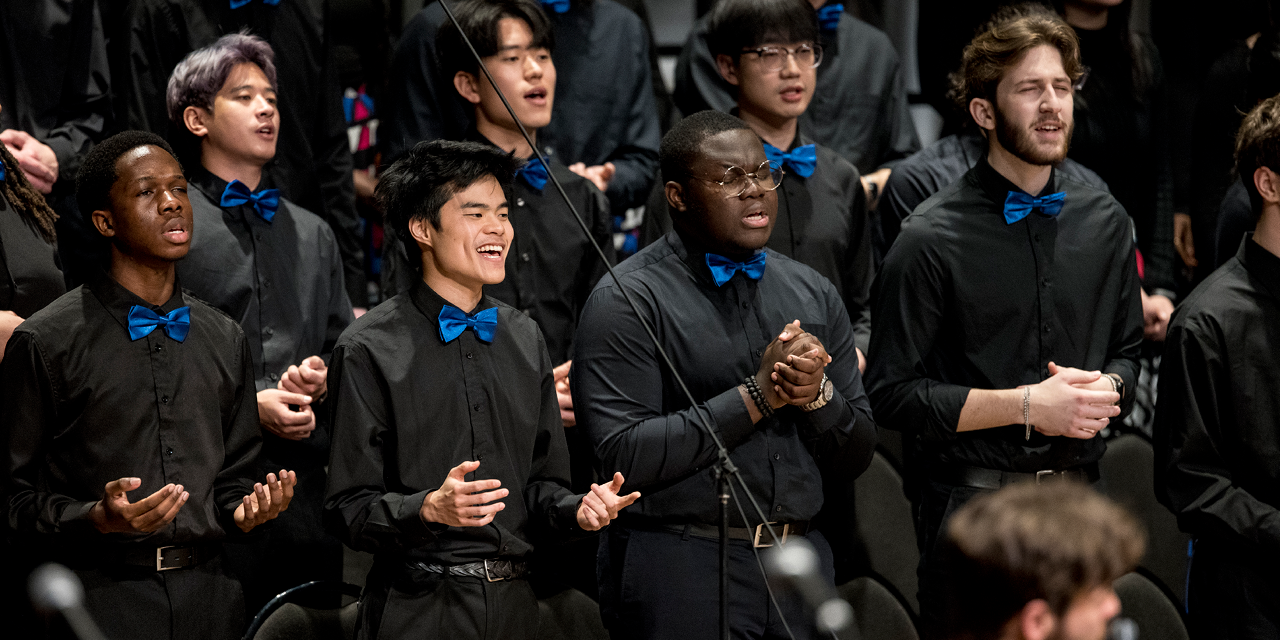
Nathaniel “Nate” Glasper Jr. directs the Calvin University Gospel Choir and serves as a campus worship associate and resource development specialist for the Calvin Institute of Christian Worship in Grand Rapids, Michigan. After twenty years as worship pastor at Grace for the Nations Church, he now serves on its ministry operations team. He also leads national, international, and summer workshops on living a lifestyle of worship. In this edited conversation, Glasper explains how gospel music and gospel choirs have changed.
How has gospel music changed over time?
Early gospel music is centered on survival, deliverance, lament, perseverance, and hope. These themes are rooted in the African American struggle. Over time, the message has widened to personal testimonies, societal issues, personal relationships with God, praise and worship, and encouragement. Today we see a mix of the traditional message with modern expressions and an increased focus on mental health, identity and self-worth, social justice, and belonging.
For example, “You Know My Name,” by Tasha Cobbs, is based in part on Isaiah 43:1–7 and reassures people of God’s presence when they feel lost, rejected, down, and mislabeled. “God Provides” speaks to people “when there’s no food to eat” and life feels like “another year of misery.” Kirk Franklin wrote the song, and Tamela Mann popularized it. “Intentional,” by Travis Greene, includes the lyrics “All things are working for my good. He’s intentional, never failing. I don’t have to worry ’cause it’s working for me.” This song emphasizes trust and hope, even when life is hard and confusing. It encourages believers to remember that God orchestrates all things for good and according to God’s plan.
What are the main genres of gospel music?
The six main genres of gospel music are:
- Traditional gospel, which is rooted in the spirituals and hymns of the Black church.
- Contemporary gospel, which incorporates modern harmonies, R&B and pop influences, and studio-produced sounds made popular by artists like Kirk Franklin, Mary Mary, Tye Tribbett, and Yolanda Adams.
- Praise & Worship, which is simple, repetitive, congregationally friendly music designed to help people participate in singing rather than just observing. Artists include Judith McAllister, Stephen Hurd, and Israel Houghton.
- Quartet gospel, which was shaped by groups like The Canton Spirituals and The Mighty Clouds of Joy. It features a tight, harmony-driven style with four-part male vocals and rhythmic drive.
- Gospel Choir / Mass Choir, which incorporates a full choir sound, rich harmonies, powerful dynamics, and often elaborate arrangements in anthems. Examples include Richard Smallwood & Vision, The Mississippi Mass Choir, and Chicago Mass Choir.
- Urban / Christian Contemporary (CCM) Crossover, which blends gospel themes with pop, hip-hop, neo soul, or rock styling. Artists include Maverick City, Tasha Cobbs, and Todd Dulaney.
What genres does your gospel choir sing? Do you use printed music or sing by ear?
Since 1987, the Calvin University Gospel Choir has been shaped by five conductors who embraced all six major expressions of gospel music. Each added their own voice to a shared legacy. What we hold today is not just a tradition of music, but a living history of leadership, growth, and faith.
My predecessor and mentor, Dr. Charsie Randolph Sawyer, taught gospel music about 90% by printed music and 10% by ear. When I became the director in 2016, I started with a 50/50 approach. Dr. John D. Witvliet, the founding director of the Calvin Institute of Christian Worship, was another of my mentors. He told me, “Be yourself. Teach gospel music how you do at your church.” So now I teach about 90% of our gospel choir music by ear. Students say how much they appreciate the ear training.
What changes have you seen in how gospel music is used in churches?
I’ve been involved in music ministry and leadership in predominantly Black churches for most of my life. I started on piano when I was eight years old. While in college, I played piano, sang, and had opportunities to lead with the Grand Valley State University Gospel Choir. I’ve spent the last twenty years as worship pastor at my church. One thing I’ve observed is how many churches no longer have traditional choirs. Instead, more and more are using rotating praise and worship teams, so you don’t hear as many choir songs anymore.
There’s been a noticeable rise in CCM crossover music in Black churches, and it’s not uncommon to hear people wonder what happened to the hymns and traditional gospel. As a millennial, I recognize how foundational those songs were for the generations before me. Our church once had a large choir, but after the pandemic, it became more challenging for individuals to commit to midweek rehearsals. Even so, we make an effort to include hymns and traditional songs on the first Sunday of the month. This is our way of passing music down to the next generation. This allows older members to teach and younger ones to learn.
Is gospel music only for African Americans, or is that a myth?
I’ve had students who aren’t African American often express interest in gospel music but question whether they’re welcome. Some ask, “If I join the choir, am I taking a space from someone of color?” The answer is no. Gospel music has cultural roots in the Black church, but its reach is wide, and our choir is one of the most diverse programs on campus.
There is also a belief that gospel music is easy to sing. In reality, it requires technique, ear training, and cultural understanding. In our one-credit gospel choir course, we meet twice a week. I open each session with a short segment teaching on gospel culture, key figures, rhythms, and history. Students complete a brief written assignment to deepen their connection to the music.
Sitting at the feet of gospel music culture involves listening first. Gospel music has roots, stories, and meaning. Culture is something you absorb. I teach students and encourage those who worship with us to listen, respect the tradition, learn where it came from, and carry it forward with understanding.
What about the idea that gospel music is simply loud and emotional?
A lot of people think so, but that’s only one part of the story. In many European American choral settings, you learn to analyze and interpret the music, and you certainly feel it. In gospel music, you do all of that— but you also embody it. You move, you sway, you respond, you express. Not every gospel piece is energetic and upbeat.
There are meditative songs as well, such as Richard Smallwood’s “I Love the Lord” and Cleophus Robinson’s “Hold On Just a Little While Longer.” Singing gospel music well requires you to learn about key modulations. And music that may seem at first glance to be mostly repetitive, simple refrains is built on richly layered harmonics.
How does a gospel choir fit in a rigorous classical music department?
This is a broad conversation (and debate) that has been going on around the world for decades. A gospel choir doesn’t take away from classical rigor; it adds to it. Gospel music is not a watered-down form of music making. It is a deeply rooted tradition with its own techniques, historical scholarship, and performance standards. One of my mentors, Dr. Raymond Wise, always says, “If you look at gospel music through the wrong aesthetic lens, you will never see its value.”
Rather than competing with classical study, gospel expands it by teaching skills like aural learning, improvisation, rhythmic complexity, cultural literacy, and embodied musical expression. For classically trained instructors and students, gospel doesn’t replace their work; it complements it and makes more well-rounded musicians. And gospel music is not simply entertainment. It is academic, theological, historical, and cultural scholarship expressed through sound. It belongs in higher education not as a side activity, but as a serious, respected discipline.
Which gospel songs work well for congregations to sing?
Make sure to match the song with a moment in worship. Performance pieces in gospel music don’t always work well for congregations to sing. It’s easier to learn “Oh, Give Thanks unto the Lord,” by Judith McAllister; “Bless the Lord, O My Soul,” by Andraé Crouch; “Come On and Praise the Lord with Me,” by Carlton Pearson; and “Every Praise,” written by J. David Bratton and popularized by Hezekiah Walker.
Because gospel music was originally taught by the call and response method, it’s a good way to teach your congregation to sing a gospel song. Especially if singing gospel music is new to your church, you should explain what you are doing and why.
LEARN MORE
Check out Nate Glasper’s YouTube channel. Read about his work creating a summer fine arts experience for youth through The Growth Center Inc. Watch a short video where Nate Glasper and pastoral musician Eric Lige discuss drawing musical resources from many cultures to worship God together. Explore Carnegie Hall timelines on trajectories of traditional gospel, contemporary gospel, praise and worship, small groups and quartets, and mass choirs. This Gifted Hands video shows how pianists can add gospel harmony to a CCM song.