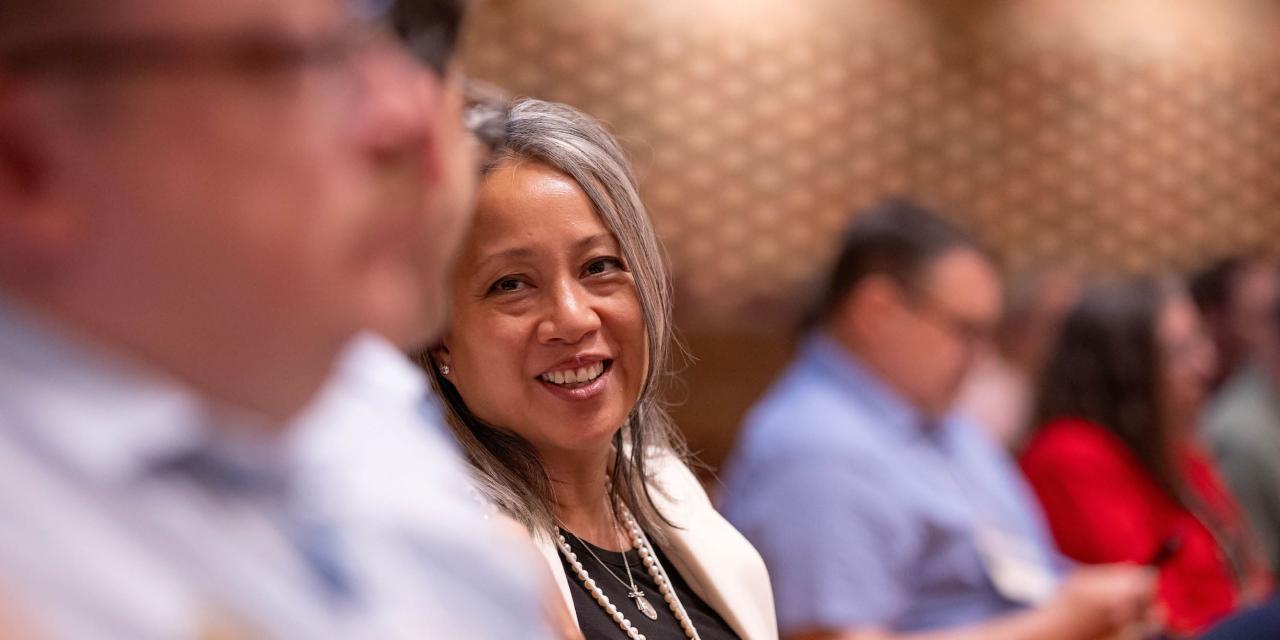
Monica Schaap Pierce is an ecumenical leader, public theologian, and the executive director of Christian Churches Together. CCT is an ecumenical community of relationships among denominations, individual churches, and Christian nonprofits in the United States. Pierce is the Reformed co-chair for the ninth round of Roman Catholic-Reformed dialogue. She has also taught theology in Catholic and Protestant universities and seminaries. In this edited conversation, Pierce discusses how to practice receptive ecumenism at church and at home.
What’s your quick description of Christian Churches Together?
Since 2006, CCT has been a living bridge across divides often deemed insurmountable.It provides a singular space in the United States marked by prayer, worship, and fellowship where Christian leaders from Orthodox, Catholic, Evangelical, Pentecostal, mainline Protestant, and historic Black church traditions come together. Our purpose is to love across difference, learn across traditions, and lead together in faithful witness to the reconciling love of Jesus. CCT’s five families of Christian tradition bring together thirty-four groups representing over sixty million American Christians.
People are surprised by our diversity. On our steering committee, 40 percent of people are immigrants, and half are people of color. This diversity reflects changes in denominations in the United States and the shift of Christianity to the Global South.
What practices shape your work?
Three practices that hold us together are faith sharing, receptive ecumenism, and contextual discernment. Faith sharing means sharing common commitments but also telling stories about how we live out our faith as members of different church families. This practice of faith-sharing is based on the Evangelical or Pentecostal practice of sharing your testimony. So it's less about the content of the faith that we share and more about one's own experience of faith in their life.
Traditional ecumenism often begins by asking what Christians can agree upon. Receptive ecumenism asks a different question: What gifts has Christ given to other Christian communities that we need to receive? Contextual discernment means discerning how to bear witness in specific places or contexts.
How does CCT define receptive ecumenism?
Receptive ecumenism is the spiritual discipline of receiving gifts that the Holy Spirit has entrusted to another part of the body of Christ. We practice receptive ecumenism so that we become more faithful and more united. It doesn’t mean that we give up our distinctives. But this type of sharing helps us become more fully ourselves. CCT helps five families of Christian tradition build relationships through conversation, prayer, worship, and experiences in local churches and community.
There’s also a more academic and traditional way to go about ecumenism. For decades, scholars and theologians have met in organized rounds of dialogue to heal rifts in the “one catholic church.” Lutheran-Reformed dialogue led to the 1997 A Formula of Agreement. It created full communion between the Evangelical Lutheran Church in America and three churches of the Reformed tradition: the Presbyterian Church USA, the United Church of Christ, and the Reformed Church in America.
Why might traditional ecumenism matter to local churches?
The 1997 Formula for Agreement means that ELCA, PCUSA, RCA, and UCC churches recognize each other’s baptisms, may share the Lord’s Supper, and may hire each other’s ordained ministers of word and sacrament. As the Reformed co-chair for the ninth round of Roman Catholic-Reformed dialogue, I join long-term conversations about justification and justice. We trust this will help us all live as a people justified by faith. We want to give witness to God’s desire for a world marked by justice.
What changes have you seen pastors and church leaders make after attending a CCT annual forum?
CCT forums help attendees encounter real people that they might have known only through stereotypes. For example, Hope for You is part of CCT’s family of Evangelical and Pentecostal churches. It’s a social services ministry in Texas that is an outreach of the Redeemed Christian Church of God. This holiness denomination is headquartered in Nigeria but works in many countries. Meeting immigrants from the RCCG and elsewhere helps Christians from other cultures gain new appreciation for their unique gifts.
CCT forum attendees bring back new perspectives to other groups they’re involved in. I’ve seen their ideas fan out to groups of bishops and leaders in the ELCA, RCA, and United Church of Jesus Christ (Apostolic), a Black denomination. Now many are making a call to unity a priority.
Any other changes you want to mention?
CCT helps Christians look for what we can affirm in common, such as the authority of Christ and scripture, the dignity of every human being, and loving our neighbors as ourselves. But we don’t try to dilute or bury our differences. At our meetings, every voice is heard and recorded. We keep our disagreements visible. We acknowledge the truth of differences between our parts of the body of Christ.
Yet we keep asking, “Based on our common affirmations, where can we reach consensus on our public witness in the world?” At times this has led to CCT statements on the gospel and poverty and mass incarceration in the United States. We have also developed a short guide on consensus decision making to help churches seek God’s will and discern how the Holy Spirit might be guiding them.
CCT helps Christians look for what we can affirm in common, such as the authority of Christ and scripture, the dignity of every human being, and loving our neighbors as ourselves. But we don’t try to dilute or bury our differences.
Even if they have no connection with CCT, how can churches promote receptive ecumenism?
There’s so much potential for this. At our church, Central Reformed in Grand Rapids, Michigan, we’ve had adult education sessions on receptive ecumenism and have invited leaders from other church families to speak. They share what they appreciate in their own traditions, such as how they pray, sing, and observe the sacraments in worship.
Some churches arrange ways to worship jointly with a congregation outside their church family or to send small groups to worship in another church. When I assigned church visiting to my religion students at Fordham University, I advised students to contact the church ahead of time. Asking about what to wear or what to expect helps visitors get a deeper experience of someone else’s lived faith.
Other churches begin to pray for neighboring congregations and pastors by name. Praying for nearby churches, especially those from other church families, helps church members stop seeing other churches as “the competition.” Some go even farther by sending notes or having conversations with the other churches and pastors to say, “Hey, we’re praying for you by name. Do you want to share any specific prayer needs?”
How can parents instill receptive ecumenism in their children?
My husband and I try to weave receptive ecumenism into everyday parenting. After an Episcopal friend from CCT talked about chalking the door and doing a blessing liturgy each year, our family started doing it. Our kids are now ages thirteen, nine, and seven. They take turns chalking. Right now my husband still has to lift up our youngest to chalk. This home ritual takes place during the liturgical season of Epiphany. It’s a tactile way to ask God to bless our house and reminds us to be the light of Christ to all who enter. We’ve also celebrated the Feast of St. Brigid on or near February 1. St. Brigid is the mother saint of Ireland, known for her care of the poor, animals, and nature. Roman Catholic, Anglican/Episcopal, and Eastern Orthodox traditions all honor her as someone who sought peace and unity.
On vacation, we make a point of visiting churches outside our own tradition. We very clearly say to our kids, “This is a different tradition than our own, but they are Christian too.” You can also learn by visiting museums, such as the Mennonite and Anabaptist heritage centers in Pennsylvania and Indiana or Black heritage museums, which often explain how faith helped people endure.
How else might Christians receive the gifts of other faith families?
Orthodox and Catholic Christians use icons, though in different ways. I’ve put icons of the wall of my home office. My favorite is of women doctors of the Church.
Many Evangelicals or Pentecostals worship in churches that don’t place much emphasis on the liturgical calendar. They can observe Advent and Lent at home by using short devotionals and singing songs from other traditions. Our family rotates among Advent and Lent devotionals from Catholic, Lutheran, and other ecumenical traditions.