HyeRan Kim-Cragg is the principal at Emmanuel College at Victoria University in the University of Toronto in Ontario, Canada, where she also teaches homiletics. She is ordained in the Presbyterian Church in the Republic of Korea and is a ministry partner with the United Church of Canada. Mona Tokarek LaFosse teaches New Testament and sacred literature studies at Emmanuel College and Victoria College at Victoria University. She also researches and teaches embodied storytelling. In this edited conversation, the colleagues discuss their 2024 Teacher-Scholar Grant from the Calvin Institute of Christian Worship’s Vital Worship, Vital Preaching Grants Program.
What’s a quick description of your grant project, and whom did it involve?
HRKC: We explored trauma-informed worship practices so that international doctoral students could reflect on immigration trauma in their ministry and for their congregations. Eight students worked in pairs to create trauma-informed worship liturgies. Two senior doctoral students, also international students, assisted us. The students are from Korea, Hong Kong, Taiwan (including one of Taiwan’s Indigenous cultures), Indonesia, and the Philippines.
MTL: These students had experience in academia and church leadership in their home countries. All are involved in Christian ministry in the Greater Toronto Area. Some are in ethnically similar congregations, others in predominantly White congregations. They speak English as their second, third, or even fourth language. All these students are racialized. In other words, they are parts of groups that have been othered by people who see them as “less than” because of their race, gender, skin color, bodies, language, accent, or socioeconomic or legal status.
How did you structure the learning?
MTL: We met six times for three hours. Our two doctoral candidates trained in trauma-informed pedagogy organized the sessions. The first session introduced trauma-informed approaches. The next four focused on an aspect of worship trauma: space, scripture, art/symbol, and supplication. Students worked in pairs to create a worship liturgy focused on one aspect. They shared their liturgies at our final session.
HRKC: Each session involved a unique meal, and students took leftovers home. We began each session with a check-in to share current difficulties and celebrate joys and successes. This trauma-informed approach helped us establish a supportive environment.
Please share a story or two about migration traumas.
HRKC: Students with the correct legal documents have been turned back by US and Canadian customs officers. I remember hearing about an Indonesian student who earned a master’s degree in the United States and had a student visa to study in Canada. She was driving with her fiancé from Boston to Toronto but got stopped at the border. Ultimately she made it in. I know of another student whose wife got permission to work in Canada, but they were denied when they crossed the US/Canada border after he attended an academic conference, so they had to go back to their home country and reapply. The immigration situation is even worse now.
MTL: During this grant, I learned so much about the complex traumas of migration. You have to come in and out of countries. People back home get sick or die. Finances are often challenging because you often can’t work on a student visa. You want to excel, and your ideas may be very good, but not everyone can understand your language or accent. And then racist things happen.
How does trauma relate to worship space or scripture?
HRKC: I taught the session on space. Most of our participants are from Reformed backgrounds, so preaching is very important. Yet many come from or now serve churches where male bodies—or, in Canada, White male bodies—are perceived as normative in the pulpit. Some women have been told in their home countries that the Bible prevents them from following their calling. The reasons given are because they are women or because they menstruate, so are unclean, or are pregnant.
Also, in many Indigenous cultures, the drum is the heartbeat of spiritual voices joined together. People dance their prayers and praise. But missionaries often banned drums and dancing from the worship space, saying that these expressions of worship are pagan. They saw using the body in a worship space as dangerous.
MTL: I taught the session on scripture. The stories of the Bible came to people in ancient times through different bodies—and they still do. So, instead of standing and reading a text, we talked about and experienced how to embody the story. This is not a performance, but an act of learning by heart (more than memorizing) and then inviting people into a story we all know.
Embodied storytellers communicate meaning and emotion through movement, gesture, posture, voice, facial expression, and physical presence. This can work even when storytellers use a language you don’t know. We also recognized how powerful and healing it can be to use non-English languages in worship, even if it’s just a phrase, short Bible passage, or one song.
How does trauma relate to worship art/symbols?
HRKC: Our students were keen to evaluate and be aware of worship art and symbols. One mentioned stained-glass windows that show only White Jesus. The women in the stained glass are all kneeling. “Where am I represented?” this student asked.
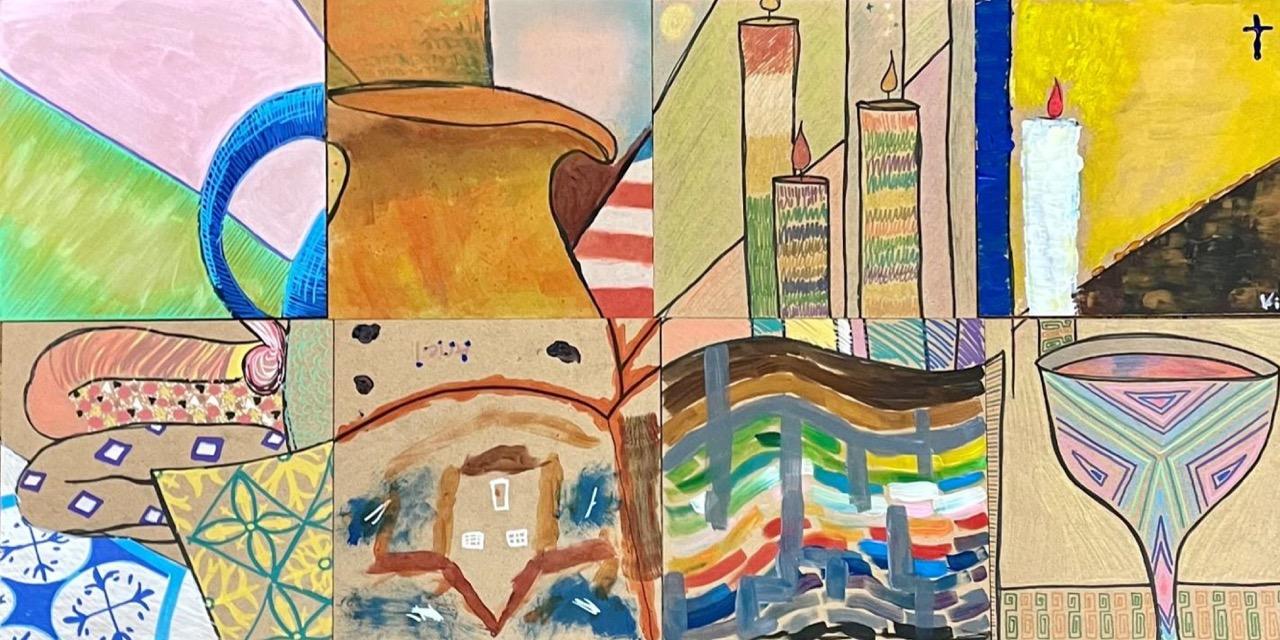
MTL: One of my favorite sessions was led by an artist who handed out small squares of paper. We painted them however we wanted, without knowing how our paintings would be used. It was so relaxing. We could chat or not. It was healing to see how the artist fitted our squares into a picture with a chalice and bread, representing the unity of the Eucharist. It made me think about how art can transcend language and culture. This kind of art has two parts: the product and the process of being together and sharing as you make art. You don’t have to be an artist to participate in the healing power of art.
What’s the significance of supplication in healing trauma?
MTL: Our speaker on supplication explained that it gives people space to remember, share their pain, and support each other. It connects prayer to real life, honesty, and relationships. Prayer is important in church and everyday life. It calls us to care for others in a world where many people carry trauma.
Prayer is important in church and everyday life. It calls us to care for others in a world where many people carry trauma.
Our speaker taught us a new way to think about supplication and public prayer. We can ask, “What happened to you?” instead of “What’s wrong with you?” This approach understands that trauma affects how people come into worship. Music can also be a form of prayer. Spoken words can bring comfort right away, while music and singing can help with deeper, long-term healing.
HRKC: A Filipino student and Indonesian student designed “A Liturgy of a Prayer Meeting of (for) Migrants.” Crossing boundaries of gender or culture while designing liturgy is healing. It gives hope that an alternative world is possible. Their prayer meeting liturgy includes time for reflection on how a person’s life and sense of home change before, during, and after their migration journey. Prayers express these traumas. They based their blessing on Romans 8:38–39 to remind worshipers that God is always on the journey with them.
How else did grant participants design liturgies?
HRKC: In European/Anglo contexts, preachers usually stand. But in Buddhist traditions and in many Indigenous cultures, the teacher sits, surrounded by the students, who also sit. Jesus sat down to give the Sermon on the Mount (Matthew 5:1). This posture of worship answers the question “Where is God?” by embodying that God is right here with us.
An Indonesian woman and a Korean man focused their “Taizé Prayer: Good Friday” service on space.
This interactive service invites worshipers to sit on cushions around a cross placed at the sanctuary center. A basin of water sits beneath the cross. All the songs are from the Taizé Community, and the service uses five languages. One idea that stood out to other students was using water on Good Friday to symbolize birth, identity, and resurrection in a trauma-informed way.
Did any services deal with Christmas?
HRKC: Yes. Korean-style Christmas services are usually fully joyful and happy. Some churches hold a separate Blue Christmas service that’s not on a Sunday morning. But Christmas for migrants, and others, can be a time of mixed emotions. Two Korean men designed a traditional Christmas service, “Christmas Worship for All (Trauma-Informed Christmas Worship),” where joy, sorrow, and pain coexist. They focused on scripture and offered an optional interactive element—“The Pilgrimage: Following the Star”—between the sermon and closing song.
MTL: The sermon text, Matthew 2:1–18, includes the stories of both the Magi and Herod’s massacre of male children aged two and under. The liturgy designers suggest using images, videos, objects, and narratives that help worshipers reflect on joy and trauma at Christmas. After all, Jesus came because God heard the cries of the world. The pilgrimage invites people to walk through an area of scripture-based learning stations. It ends at a wall with a giant star. Worshipers may write and place sticky notes on the wall. Their notes can offer up their laments, prayers, praises, or confessions.
Which service focused on symbol and art?
HRKC: A woman from Hong Kong and a man from the marginalized Siraya people group in Taiwan designed a liturgy called “Enter God’s Refuge and Seek Healing: The Healing Liturgy of Trauma in Siraya Cultural Identity.” The man, Victor Tung, cofounded the Grace Bamboo Sacred Music Ministry and published The Lord Is Our Refuge: The First Contemporary Hymnal in the Siraya Language in 2025.
Their liturgy uses traditional Siraya cross-stitch embroidery and stories and music inspired by Siraya culture. It invites worshipers to embroider simple patterns that reflect their own pain and hope, such as a heart, a tear, or a ray of light. At the end of the service, the small embroidered fabrics are sewn onto a bamboo tree. This symbolizes how what is broken can be rewoven by God’s healing hands. Like the other students’ liturgies, this one can be adapted to engage trauma, culture, and faith with pastoral sensitivity and thoughtful theological imagination.
How can churches and theological schools apply your grant learning with international migrants?
MTL: Invite people from other cultures to tell you what they’d like to see or share in worship. Maybe they’d like to see their language printed in the bulletin or projected on the screen. They might want to lead a prayer or song or do embodied storytelling in their heart language. Perhaps they’d like to dress in traditional garb and explain, introduce, or teach something about their culture. They might like to loan a communion tablecloth or Christmas or Easter decoration from their home country.
Some international people have amazing language skills. Other migrants may have wonderfully creative ideas but feel shy or have difficulty communicating in English. One option is to provide information or questions ahead of time so they can prepare for worship planning sessions or Bible studies. Recognize that students or preachers whose first language is not English may need more time to prepare prayers or a sermon in English.