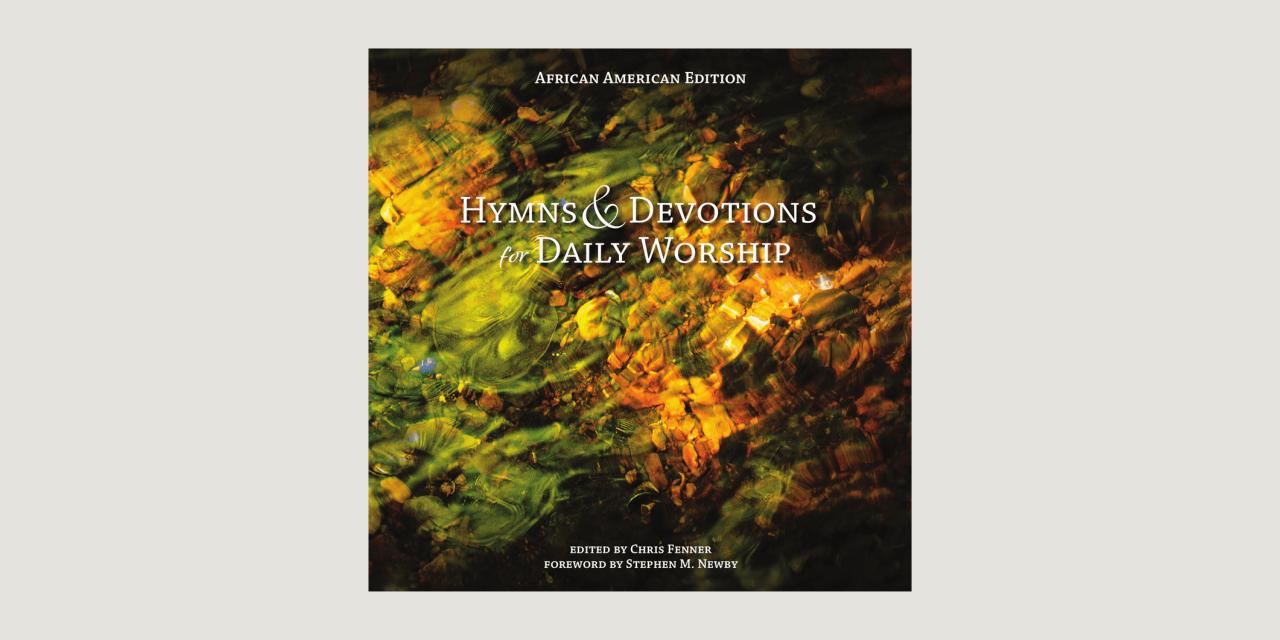
Chris Fenner is a hymnologist, archivist, and church musician. He is the digital archivist at the Southern Baptist Theological Seminary in Louisville, Kentucky. He founded and edits the Hymnology Archive, is a volunteer editor for Hymnary.org, and is a contributor to the Canterbury Dictionary of Hymnology. His most recent books are Hymns and Devotions for Daily Worship (Hymnology Archive, 2024) and Hymns & Devotions for Daily Worship: African American Edition (Hymnology Archive, 2025). In this edited conversation, Fenner describes how his original hymns and devotions book led to an African American edition.
What makes Hymns and Devotions for Daily Worship and the African American Edition unique?
While many daily devotion books are hymn-based, Hymns & Devotions for Daily Worship (HDDW) stands apart in several ways. Most books in this subject area are nonliturgical, but mine follows the church year, and it coordinates with the Revised Common Lectionary (RCL), which grounds the selection of hymns in scripture. In addition to featuring several psalms, the book has more narrative hymns and hymns about Christ’s life and ministry than most congregational hymnals.
All hymns have singable musical settings, so the book is useful for group study and worship. Finally, wherever possible, I wanted the hymn writers to speak for themselves. Most living authors agreed to write devotions for their own hymns. I found sermons and devotional material to represent classic writers. The same is true for the African American Edition (AAE). I interviewed composers, descendants, and colleagues to capture priceless stories from that tradition.
What led you to create the new African American Edition?
For HDDW, Stephen Michael Newby composed a new tune, NATIONS RAGE. Newby works closely with the Black Gospel Archive and its Black Gospel Music Preservation Program at Baylor University in Waco, Texas. His new tune was for Richard Allen’s “See How the Nations Rage Together,” which last appeared in a hymnal in 1801. Allen founded the African Methodist Episcopal Church, a historically Black denomination. Allen’s text paired with Newby’s tune fits in Ordinary Time (HDDW #353 and AAE #51) and is associated with Mark 13:8 (“For nation will rise against nation . . .”). Newby asked me to create a fully African American edition of the book, and he wrote the foreword for AAE.
We both believed a new collection of Black church music, enriched by personal devotions and stories, was important and needed. Hymnals for Black churches are widely available but often lack historical documentation in the form of companion volumes. For the AAE, we included that kind of careful documentation, and we created new, historically accurate scores.
How did you fill that scholarship gap?
As a historical hymnologist working for a seminary, I have abundant access to books, hymnals, and digital resources. I selected HDDW hymns to follow the narrative arc of the church year and lectionary. These songs represent two millennia of Christian hymnody across eras, denominations, and cultures around the globe. Finding and selecting hymns, then securing devotional materials from those hymnwriters and others was intensive!
The AAE spans from 1760 to the present day. I carefully traced song sources, produced new scores, and compiled brief biographies of all Black authors and composers. Compared to more than four hundred hymns in HDDW, this edition has eighty-nine songs—one or two per week. It lays the groundwork for an expanded edition in the future.
What is the oldest hymn in AAE?
The oldest known hymn text by an African American writer is “Salvation Comes by Christ Alone (AAE #20),” a fitting song for the season between Easter and Pentecost. Jupiter Hammon wrote it in 1760. I found the text while looking for materials in Conversations with God: Two Centuries of Prayers by African Americans (HarperCollins, 1994), by James Melvin Washington. Washington was an African American historian, educator, and Baptist minister.
Jupiter Hammon was born enslaved yet was educated alongside the children of his owner, Henry Lloyd, on Long Island, New York. Lloyd educated him into Christianity, though neither he nor his descendants ever freed Hammon. Astoundingly, “Salvation Comes by Christ Alone” had never been included in a hymnal. I commissioned a new tune by Raymond Wise, an African American music scholar and composer at Indiana University. Wise named his tune JUPITER in honor of the poet.
Can you share any favorite anecdotes from working on HDDW?
I really enjoyed working with Lutheran writer Gracia Grindal. I needed a hymn for the famous passage in Proverbs 31 about the godly woman. Grindal wrote a beautiful interpretative paraphrase called “The Proverbs 31 Woman” (HDDW #301). Its first line is: “Her children rise and call her blessed.” We honed it together to speak meaningfully to the concerns of our present society. It’s a good song for Ordinary Time.
One of Martin Luther’s earliest attempts at writing hymns was his paraphrase of Psalm 130. Grindal provided a long-lost stanza for her translation of Luther’s hymn “Out of the Depths I Cry to You” (HDDW #115). The hymn was reduced to four stanzas when it was printed in the Lutheran Book of Worship (1978). Now it is printed in full for the first time. I got to meet Grindal in person and express my appreciation at the 2025 Hymn Society conference in Detroit, Michigan.
And how about AAE stories?
I wanted to include information about Kenneth W. Louis, who died in 2020. He had served as minister of worship and music at Holy Comforter–Saint Cyprian Catholic Church in Washington, DC. The church put me in touch with Marcia Leftwood Holton, one of the original recorded soloists for his song “Taste and See ” (AAE #48a). We had a beautiful conversation about her work with Louis and how she still deeply cherishes that song.
I also enjoyed talking to Shirley Berkeley, a 96-year-old church musician in metro DC who knew Louis. Mother Berkeley shared stories about him and about her own music, such as “I Will Bless the Lord at All Times” (AAE #37). She sent me her official score, which is often misprinted in hymnals. These conversations and many others made it a joy to include personal stories in the book.
Who is your intended audience?
These two collections will appeal to hymn lovers of all types, but especially those who worship in liturgical settings or those in educational settings, such as Sunday school classes, seminary classes, and home schools. As a former church music director, I know how hard it can be to find music that fits a sermon or occasion. Both collections follow the RCL and include scripture indexes. This makes it easy to find songs by biblical theme.
The HDDW features a table of contents arranged by Bible narrative, and both collections are fully indexed on Hymnary.org. These books are intentionally ecumenical. Nonliturgical users will appreciate the HDDW’s clear essays explaining the church year. Readers have praised both books as rich in learning, beauty, scholarship, depth, and usefulness.