|
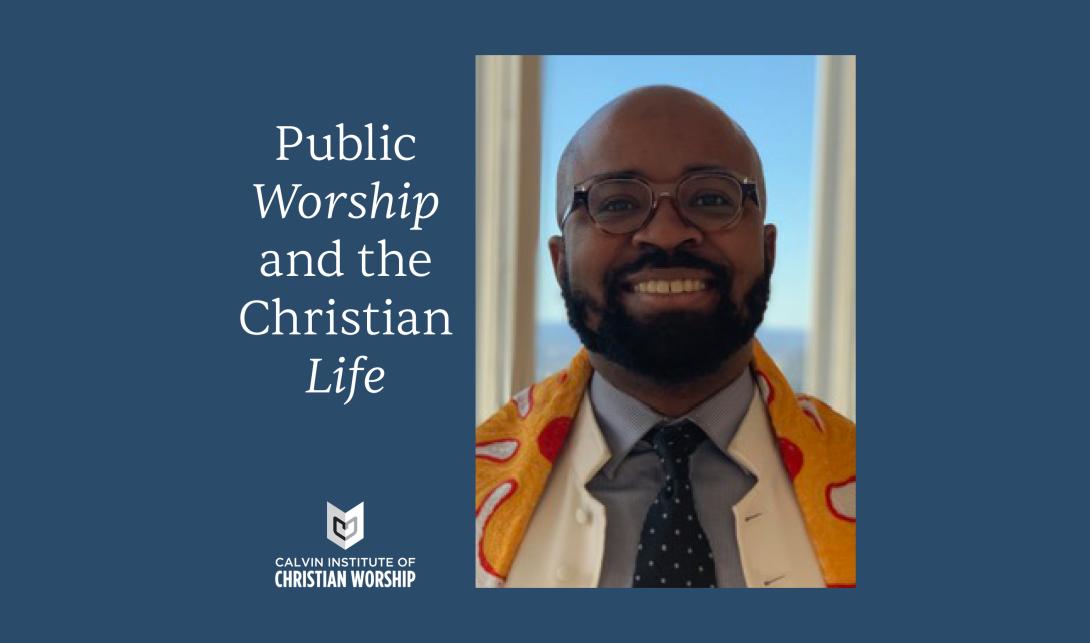
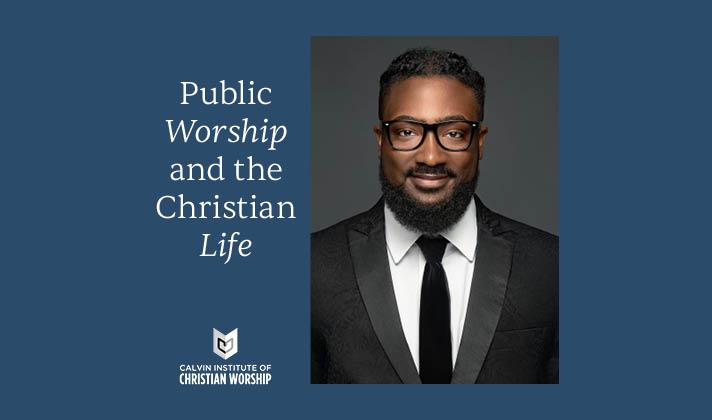
Vinroy D. Brown Jr.
00:00:05
|
00:00:05
|
Black music is for everyone. Our music tells the story of a very centralized and demographically singular experience. But the music is accessible to everyone, and the music should be accessible to everyone because musicking and storytelling are the ways in which we share our story, right? And when we think about the Bible, it's a collection of shared experiences and stories.
|
|
|
Kristen Verhulst
00:00:43
|
00:00:43
|
From the Calvin Institute of Christian Worship, you are listening to Public Worship and the Christian Life, a podcast that amplifies people and stories that share wisdom and wonder about Christian public worship. This season for the podcast, we are dwelling in the psalms, the prayer book and songbook of the Bible. Welcome to the podcast.
|
|
|
Satrina Reid
00:01:13
|
00:01:13
|
Hello, my name is Satrina Reid, and I'm a program manager here at the Calvin Institute of Christian Worship. And it is my pleasure today to host the episode on Black psalmody, where we will explore the vibrant intersection of Black sacred music and the psalms, and we will learn about Black composers and how they have reimagined the psalms through choral music, spirituals, and gospel tradition. So whether you're a worship leader, music educator, or simply curious, this conversation, we hope, will inspire you to dwell more deeply in the psalms. And to have this conversation, I am so grateful to welcome Vinroy D. Brown Jr. Vinroy comes to us from the historic Abyssinian Baptist Church in New York City, where he is the minister of creative worship and music and also the artistic director and conductor of Capital Singers of Trenton. Vinroy is a conductor, a musicologist, and an educator with academic and professional experience in choral conducting, sacred music, and music education. He also currently serves as adjunct assistant professor of sacred music at Westminster Choir College, where he conducts the Westminster Jubilee Singers and teaches in the baccalaureate honors program. He also directs the Westminster Vocal Institute and is the founder and curator of the university-wide celebration of Black music. In addition to this, Vinroy is also working on a doctorate in the area of music with a concentration in musicology and with additional coursework in Africology and African American studies at Temple University. I also need to say, in addition to all of what I just said, that Vinroy is also the curator of the Black Psalmody database, which is the first comprehensive compilation of choral psalm settings by Black composers. So a hearty welcome to you, Vinroy.
|
|
|
Vinroy D. Brown Jr.
00:03:30
|
00:03:30
|
So glad to be here. Thank you for having me.
|
|
|
Satrina Reid
00:03:32
|
00:03:32
|
It's good to have you. When I happened upon this database, I found a treasure trove. I was so excited to find it, and I was also very curious. So can you tell me, with all of your studies, one of the things that I also meant to mention that you also have a practical theology degree as well. So you're not only into academics, but you're also into theology and all of that intersects, I think, in Black sacred music. And so with that, I was hoping that you could tell me a little bit more about your research interests and how you came upon Black psalmody. And actually, what is Black psalmody?
|
|
|
Vinroy D. Brown Jr.
00:04:13
|
00:04:13
|
Yeah, so I am a researcher who really seeks to elevate and promote the music of underrepresented composers. In my own experience, I am a champion—I hope, I wish to be a champion, I should say, of music of the Black experience and the music of women composers. And that research has led me along a really beautiful journey with different stops along the way based on the specific research need at the time. So a lot of my research or a lot of my scholarship comes out of research that I needed to do, whether it be for the purpose of programming music, for the purpose of serving the church, or even for the purpose of writing in the academy. And so all of my research, while rooted in Blackness, has many different stems to it. And it's created a really fun and beautiful kind of academic life for me that I that I'm blessed to enjoy.
|
|
|
Satrina Reid
00:05:28
|
00:05:28
|
It sounds like it. And so out of that, we have this database of what you call the Black Psalmody database. Can you talk a little bit about what inspired the database and exactly what Black psalmody is?
|
|
|
Vinroy D. Brown Jr.
00:05:47
|
00:05:47
|
In Black storytelling, we're kind of always paying homage and looking back a little bit as we look forward, right? That idea of sankofa. And I teach at Westminster Choir College, but I'm also a graduate of Westminster Choir College. I got undergraduate degrees in sacred music and music education from Westminster. And while at Westminster, I sang in many ensembles, one of which was the Westminster Jubilee Singers, an ensemble dedicated to music of the Black expression and experience. I came back to conduct this ensemble two years after graduating. And in the fall of 2018, I needed to program a concert of psalm settings by Black composers and could not find them, or at least find them easily at the time. So I did what we all did back then and kind of still do now. I went onto social media and I said, “Hey, I need to program music by Black composers. I need to program psalm settings by Black composers. What do you have out there in the world?” And a lot of my colleagues gave me repertoire. A number of them we actually ended up programming with the ensemble. And then part of me said, well, It shouldn't have been this hard to find this music. Like, I shouldn't have to cast a worldwide net to find music for what ended up being an eighty-minute concert. So I said someday I'm going to compile all of this and put this together. And I tabled that at the time because I needed to program some other repertoire. I ended up diving into women composers. And I will say a lot of my early research came as the result of needing to program concerts for Jubilee and understanding the role of the Jubilee singers at Westminster in kind of educating the campus community on the diversity of the expression. So I put that away because I then spent the next two years doing intense research and writing and presenting on Black women composers and their music. And during the pandemic, I was home and said, you know, well, maybe this is a project I should pick up again. And a very dear friend of mine [is] Dr. Marcus L. A. Garrett, a choral musicologist whose research is in the non-idiomatic music of Black composers. So I put it together and I was like, “Marcus, what do you think of this?” He was like, “Oh, it looks great to me.” I was like, “Yeah, I'm going to publish it in three months.” And he was like, “OK, but what you showed me was done.” ... And I still kind of waited a little bit, but then eventually I was like, I'm going to publish this. I know for me as a church musician, I needed a resource like this, and I found that a lot of people appreciated the research, and it's living research as people are able to contribute to the database in in real time.
|
|
|
Satrina Reid
00:09:12
|
00:09:12
|
What a journey in doing that. It's always interesting how you can be about your business of just doing your work and you discover something that's needed. And now we've got this database not just for your work, but for others to also be able to benefit from and to explore. So I was wondering about, as we talk about or think about the psalms, how have the psalms you have seen through your research functioned as both a spiritual and cultural resource in the Black sacred music tradition?
|
|
|
Vinroy D. Brown Jr.
00:09:48
|
00:09:48
|
Well, you know, psalmody in in its own traditional framework refers to the singing of psalms or canticles, smaller songs, typically in congregational worship. And for me, the idea of Black psalmody is a method to me. It's a method that has a kind of three-pronged approach, so to speak, when you deal with the Psalter. And the approach is always first theological, because we are dealing with sacred texts. And then it is musicological because the psalms are songs. We're dealing with not only words, but we're dealing with music. And then it's historical when we put it in the framework of Blackness or look through it through an Afrocentric lens. So that's kind of how I approach psalmody and I approach my own research of this. Of course the expressions shared in the psalms go far beyond Blackness. We all have felt lonely. We've all felt happy; we've all felt sad. But there is a unique correlation in my experience, particularly when I consider the Psalter as music, to at least America's parent music, which is the Negro spiritual. So those two approaches meet in that this is an approach to analyzing and looking at this text set to music with all of the characteristics of America's indigenous music, which is Black.
|
|
|
Satrina Reid
00:12:05
|
00:12:05
|
I like that when you look at the musical, the theological, and the historical, we find that in the psalms and we find that in our lived experience, in the Black experience. And so I'm wondering oftentimes in that lived experience, I start to think about the theological aspects of it. And some of it probably, we can also say sociological in some ways too. The Black experience often has times of lament and praise, praise and lament, and all those emotions in between that we find in the psalms. And so I was wondering how do you see some of these ... I'll say the two central themes of praise and lament resonating in the Black musical experience, and particularly some of these settings that that have been included in your database.
|
|
|
Vinroy D. Brown Jr.
00:13:04
|
00:13:04
|
Yeah, well, when we consider when we consider the Psalter and we consider the types of psalms, they kind of do live in those macro themes of praise and lament. But even in those macro themes, there are micro themes, right? When we think about the types of laments in the Psalter, you have communal laments, right? The community coming together to mourn, the community coming together to weep. And then you have those individual laments. Think about the psalms that David wrote when he was crying out to God. That was his own very personalized, unique experience, right? And then when we think of the praise psalms, we have hymns, which are songs of praise to God. And then psalms of thanksgiving, and psalms that speak of lineage and royalty. These types of psalms are, in essence, the experience of the believer. I guess the advantage of the spiritual lens through which they can see their lived experience. And it's important that worship, at least in my own concepts of worship framing, that all of those experiences are lived in a worship experience, because the people who gather to worship are going through all of those things in conversation with each other at the same time. And when we think about the Black expression, the Black experience, we could be crying and singing, and in five minutes jumping and singing. And it may not be that we are any happier than we were four minutes and fifty-nine seconds ago. But it could be that there is something in the music and the expression that frees us to emote, that frees us to be present with our humanity. The beautiful thing about it is that all these things happen, and they kind of converge at the same time in a really beautiful way.
|
|
|
Satrina Reid
00:15:14
|
00:15:14
|
In beautiful ways. And I like the fact that we can talk about a particular people. In the psalms, the psalms relate to a particular people, and we just talked about the Black experience and the Black expression of lament and praise, but it can also, as you said, be for all people, because we all have the experiences in life that will bring out the various emotions that the psalms allow us to actually experience and express. And so that's one of the things that I love about the psalms, is that it gives us the freedom to express those emotions that in in a society that would say, Oh, you know, you’ve got to be buttoned up, or you've got to be a certain way. No, the psalms actually free us. And then in the Black expression, I think the psalms free us to be ourselves in all of our experience of whatever that is at the particular time, whether it's in a historical context or in the present. And so I'm wondering, if you can in your imagination scroll through your database, if there are some examples of psalm settings by Black composers that you find enriching or the ones that if you had to get rid of some ones that you would hold on to and that you couldn't get rid of.
|
|
|
Vinroy D. Brown Jr.
00:16:44
|
00:16:44
|
Oh, my gosh. I've grown in my collecting of these pieces. I've grown to love all of them. They're all like my children. And I just happen to have, you know, a hundred and something of them.
|
|
|
Satrina Reid
00:16:59
|
00:16:59
|
Like 150?
|
|
|
Vinroy D. Brown Jr.
00:17:01
|
00:17:01
|
I think it is about 150. I'm trying to get all of the psalms represented, but not all of the Psalter has been set to music—in our contemporary context, I should say. So if anyone wants to go to my database and look at the psalms that we don't have and would like to add one, go for it. Songs that come to mind immediately: Nathan Carter's “Psalm 1.” Nathan Carter actually has several settings of the psalter. He set Psalm 1, I think he set Psalm 150. Those are two of my faves. A nontraditional setting would be R. Nathaniel Dett's arrangement of “Go Not Far from Me, O God,” [which] is inspired by Psalm 6. And what I love about the music of R. Nathaniel Det is that he approached creating Black music through a Eurocentric lens. And it served him well during his time at the turn of the nineteenth and twentieth century. And he would set, for example, spirituals in the style of anthems or in the style of motets. And “Go Not Far from Me, O God” is one of those settings. It's not a spiritual; it's an original work. But it still has characteristics that are rooted in in Blackness: the harmonic structure, the way in which he introduces the lines that begin the piece, it feels like the wail you would hear in a spiritual. It feels like that mournful kind of quality, that drooping that you would almost feel doing a chorale or a chorus from a Bach Passion, because he's thinking about his music and its and its composition through his very trained framework in partnership and conversation with his lived experience. So for me, he is quintessential Black classical in that regard because of that. Adolphus Hailstork’s “I Will Lift Up Mine Eyes” is a three-movement cantata. All three different psalm settings, beautiful, accessible, lovely music. I'm always a champion of the music of Rosephanye Powell, who is the world's most published Black woman composer, and she has several settings of the psalms that I love, particularly her setting of “As the Deer Pants” for soprano/alto/chorus, for treble chorus. I could go on and on, but there are beautiful settings. George Walker, the first African American to win the Pulitzer Prize for Music. He is one of the stems of my research tree as I spent a year during his centennial writing and publishing about his music. He has very complex but very beautiful settings of the Psalter. I mean, Florence Price, her “Praise the Lord.” You know, I could go on and on, but Marvin Curtis's hymn of consecration, “I Was Glad When They Said unto Me,” let us go to the house of the Lord. So I could easily give you a top ten. I probably already gave you a top twelve.
|
|
|
Satrina Reid
00:21:01
|
00:21:01
|
You know, people can't see me, but I'm grinning from ear to ear because it's just the beauty of all of those settings that you've just mentioned. I wonder if all of these examples that you've mentioned ... I want to move kind of into probably a more practical kind of, an integration kind of discussion about how to integrate some of these settings into worship. Our audience is diverse, both ecumenically, ethnically. So, how can a church or churches or even the academy incorporate Black psalmody into their worship or into their music programs? What would be some practical tips for those who lead worship and for educators?
|
|
|
Vinroy D. Brown Jr.
00:21:52
|
00:21:52
|
Well, the good news is theologically, the psalms are pretty universally accepted, you know. We don't have to get into Old Testament versus New Testament, covenant or not covenant, all of those theological discourses that I enjoy dabbling in from time to time. We don't have to get into it with the psalms. And I think it's in part just because the psalms provide us such a diverse offering. And the psalter is so large you can pick what applies to your context. I would encourage ministers of music and ministers of word and sacrament alike to consult the database. What I like about the database is it shows where everything is published so that you don't have to go and ... once you have the listing, you know where to find it. I know in a lot of contexts, psalms usually begin worship or happen rather earlier in the worship program. And I think, just because classical music, has patterns and trends, most of the psalms that you would sing in worship, there are settings that can be found in the database. And I think that swap is quite doable. I also would say that I know oftentimes colleagues who aren't steeped in the Black experience may have a hard time with the music in that some of it can come from the oral tradition and feel inaccessible in that regard. But all of this music that is in my database at least is transcribed. You don't have to reinvent the wheel. You can do what's on the page and it be an authentic Black expression. And ultimately, I also think you can do it without necessarily highlighting the fact that this week's psalm setting is by a Black composer. I think the music actually stands, to its own merit. And you can just do it because it's a really good psalm setting. And that's the beauty of the list. People can contribute to the list, and I know we'll talk about that a little later, but I do vet these scores to make sure that we're providing you quality. So I think seeing what works for your ensemble, there are many different types of voicings. Not all choirs have sopranos, altos, tenors, and basses. Some choirs have no tenors. So you can also see on the database the kind of voicings that you need for your ensemble. And we're swapping out, we're doing excerpts, we're doing full pieces, or we're doing them even outside of the context of worship. We're doing them in what would be, I guess, considered sacred performance, which I think also has value. So that's how we partner together to bring these to the worship setting. I think you're looking for the pieces that work in your context. The database also has ... the first thing you see is like, all right, what psalm is this song derived from? So [if you] need a psalm setting, but need something from Psalm 119, all right, you can go to 119 on the database. You can look for what you need and see if it works for you. So I think knowing your context helps you navigate this resource.
|
|
|
Satrina Reid
00:25:47
|
00:25:47
|
I like that. You mentioned that it's music for everybody. But it's also, when I see it, it's also an opportunity for those people who may not be steeped in Black sacred music to have an opportunity to teach about what you mentioned: underrepresented composers. So even knowing about who these composers are, I think it's an excellent way of teaching ... folks [who] have never heard of the composers that are in the database. But it's also another way of teaching about those underrepresented composers, I would think, to those who want to know.
|
|
|
Vinroy D. Brown Jr.
00:26:30
|
00:26:30
|
I would agree.
|
|
|
Satrina Reid
00:26:30
|
00:26:30
|
But it's accessible to anybody.
|
|
|
Vinroy D. Brown Jr.
00:26:33
|
00:26:33
|
To anybody. And I I would say two things. One, I'm very intentional about the language I use. Words matter, right? And I think the Psalter teaches us that words matter. David set a lot of words to music, his and those who authored the other psalms. It's underrepresented composers of the global majority. Because Black and brown, there are there are more of us globally, and I use Black psalmody and not African American psalmody because Blackness is bigger than the two hundred and fifty years the United States of America has existed in this form. That's number one. Number two, I cannot stress how much value there is to the understanding that Black music is for everyone. Our music tells the story of a very centralized and and demographically singular experience. But the music is accessible to everyone, and the music should be accessible to everyone, because musicking and storytelling are the ways in which we share our story. And when we think about the Bible, it's a collection of shared experiences and stories, sometimes, oftentimes, stories of underrepresented people who comprise the global majority. So it's for everyone. It's not just for those who identify with the kind of cultural, lived experience. But then those who don't, to your point, have an opportunity to learn and to do the work and to approach it with the the caliber of research it deserves to present this in worship. As ministers of music, we are responsible for crafting an experience that allows people to experience God. That's weighty. And it does take that level of research and thought and prayer as we put this together in our sacred context.
|
|
|
Satrina Reid
00:28:57
|
00:28:57
|
As our time comes to an end, I want to ask you what are your hopes for Black psalmody, for the database, how people view the psalms, how people view it in the in the Black sacred music context? And then finally, then, how can listeners support or contribute to the Black Psalmody database?
|
|
|
Vinroy D. Brown Jr.
00:29:26
|
00:29:26
|
God is truly amazing, because even this has surpassed any expectations I ever had for what I thought was just going to be a database buried on my website somewhere. But as I continue to discern and as I ... I've always been thinking about crafting worship, but even more so in my tenure at Abyssinian, such a historic church. I am, I guess, really formalizing and writing down the framework for Black psalmody that's kind of been in my head all these years and my lived experience has helped craft. But putting it on paper, creating that kind of formalized framework for how we approach Black psalmody, how we approach kind of the paradigm that we're hoping to create, the methodology that at least I've used to interpret this sacred text and this music. So that's my hope for the database, that it continues to be more of my think tank. But I do think I'm being called in this season to really commit myself to its research and to really formalize and further develop so that this can be a greater resource. And finding collaborators to do it with. I've never thought that research should be restricted. I understand in the academy sometimes, particularly as a PhD student, I can see the kind of gatekeeping of ideas, but you can't gatekeep the Bible.
|
|
|
Satrina Reid
00:31:18
|
00:31:18
|
Well, no.
|
|
|
Vinroy D. Brown Jr.
00:31:19
|
00:31:19
|
So you know, the the essence of my research is very public, and I'm happy to partner and share with that. And of course, I'm always accepting submissions to the database. If you go to vinroydbrown.com/blackpsalmody, you'll find the database, and there is a section where contributors can contribute. And I've found that there have been some composers who I had not heard of until they sent things in to the database for publication. So that's kind of where I see it going, and that's how I hope people will partner with me to continue to bring it to life. And a lot of these publishers are different, but I would like to see book of all of these settings in one place. Right now I am working on and I've explored the idea of a physical house for this database at Westminster Choir College or somewhere at Abyssinian or some other institution or maybe at Calvin, who knows? But a physical space for this collection, a book of this collection, some research, some articles that would accompany it, and then of course always welcoming new contributors to the database so that our list can grow. Hopefully, I would love to have at least each psalm represented with one setting.
|
|
|
Satrina Reid
00:33:08
|
00:33:08
|
This has been such a rich and beautiful conversation. Thank you for your work. Thank you for leaning into the research, because sometimes people just do research for the assignment at the time. But thank you for leaning into it and building something that's living on the site and is available and accessible to the masses. And we hope that other folks will actually take advantage of the work that you have done. You can find the database at vinroydbrown.com/blackpsalmody. Thank you so so much. I just have to believe that this conversation is going to encourage some people, have some people curious about Black Psalmody, the database, and I won't be surprised if you got some more contributions to the database because of this conversation. So thank you again. Best wishes to you and all of your work.
|
|
|
Vinroy D. Brown Jr.
00:34:17
|
00:34:17
|
Thank you for having me. I look forward to seeing where this conversation goes.
|