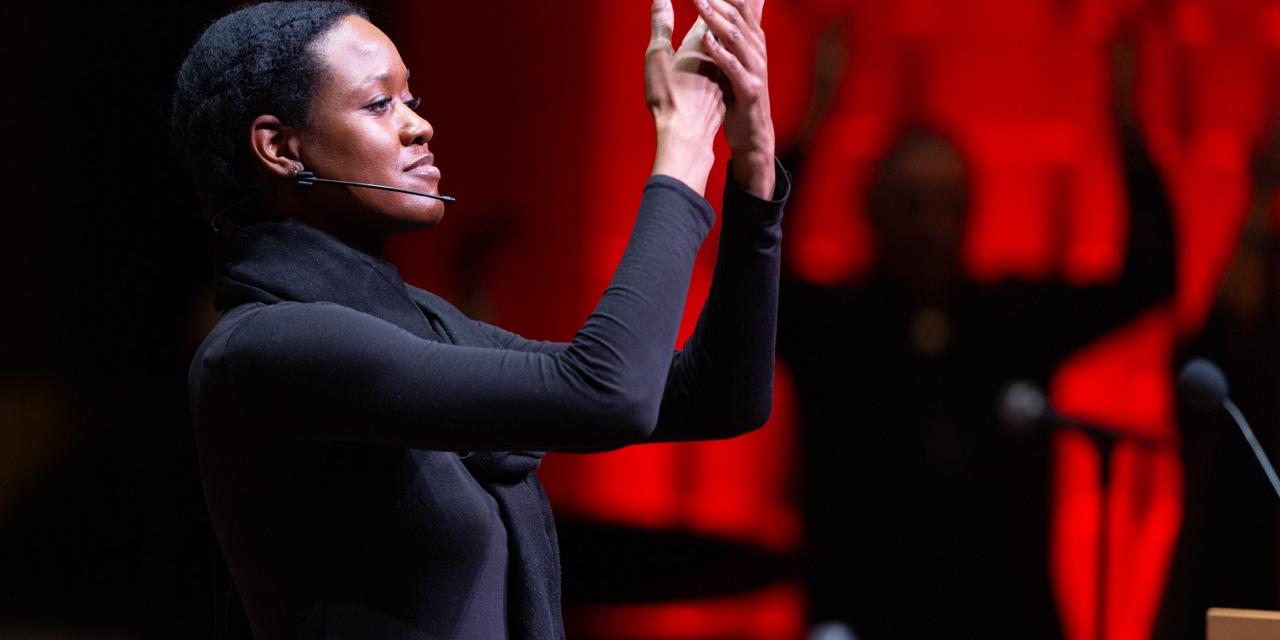
Dea Jenkins is an award‑winning multimedia artist and speaker in Pasadena, California. She has two master’s degrees from Fuller Seminary, both focused on theology and the arts. Jenkins has collaborated with Duke Divinity School, Fuller Seminary, Princeton Seminary, and Alabaster Co, and she has led workshops in many churches. She is also an entrepreneur and curator who creates spaces where people can explore how art, faith, and social healing connect. In this edited conversation, Dea Jenkins explains how groups and congregations can make visual prayers to receive from and respond to God in hands-on ways.
Where did you get the idea to do visual prayers—and what are they?
I got the idea from Dinean Davis when she was leading a dance ministry at the historic First Corinthians Baptist Church in Harlem, New York. We learned as dancers how to express our prayers to God through movement. It’s not that we’re trying to replace written or spoken prayers. We are simply adding a layer to prayer.
I think of a visual prayer as an embodied response. It’s an opportunity to express ourselves in a way that can bypass language, especially if you are having trouble coming up with the right words. Romans 8:22–26 explains that the whole creation groans, we groan inwardly, and the Holy Spirit intercedes for us through wordless groans.
How does a leader prepare to lead others through visual prayers?
As a leader, you need to take time to become comfortable in your own body. Ask, “Holy Spirit, what do you want to share with the group?” Throughout the process of creating visual prayers, I’m constantly depending on the Holy Spirit’s guidance.
The leader also needs to prepare worshipers or audience members by pairing something familiar with the unfamiliar. You might say something like, “We’re all familiar with prayer in worship. Today we’re going to do something a little different with our prayers.”
Sometimes the leader will pray a verbal prayer to add to people’s comfort level. You can explain that there is no right or wrong way to use gestures in a visual prayer. Your opening words or prayer can explain that, from God’s perspective, words are not needed in prayer, though using words can help us. God is fluent in the language of you, so God knows what you mean as you move your body in visual prayer. The key is to keep this preparation no more than a minute long.
How do you make it easy for people to participate in visual prayers?
Always be gentle and affirmative. Never make them feel like their gesture is wrong. Even if all someone does is raise one arm, you can say, “This is beautiful, lovely. I feel the Spirit’s presence.” Since you, as a leader, are depending on the Holy Spirit, you can confidently shift the focus from people’s movements to what God is doing in the gathered worshipers or attendees.
One example of a visual prayer element might be swaying our arms back and forth to ask God to stir up our creativity. Groups can try creating three-step prayers:
- Leader creates a gesture in response to what’s just been heard. People mirror it back.
- People each create their own movement to respond to a word or phrase that stuck with them.
- Leader shares a movement for everyone to mirror. This third gesture is the same no matter what words people are responding to.
Do you recommend any other preparation before a three-step prayer?
Before sharing a movement for our first step of visual prayer, I help them warm up. I might
ask them to bend their knees, wiggle their toes, sway side to side, lift their shoulders, and so on. This helps them get into their bodies right away.
What’s your typical first step for visual prayer?
The first step helps people pair the familiar with the unfamiliar. I share a word or phrase from what we’ve just heard (familiar). Then I create a simple visual response for them to mirror back to me (unfamiliar).
Here are some different first steps I offered for visual prayers following short talks on the psalms by speakers at the 2026 Calvin Symposium on Worship.
What do you invite people to do next?
I invite them to think of a word or phrase from the talk, worship element, or sermon we’ve all just heard together. Then I ask them to find a gesture to mirror that word or phrase. You don’t have to be a dancer to do this. Your gesture doesn’t have to be profound. It can be large or small. Whatever comes to you, simply trust the Holy Spirit’s work in you. Here you can see the varied movements people have created for this second step of prayer.
What is the third step?
The third step is always the same for any visual prayer we put together. It symbolizes “Lord, hear our prayer” and “God, we receive your response.” Some people respond to God most in their emotions, so they can bring their crossed hands to their heart. Others feel God speaking to them most in their gut, so they can bring their crossed hands to their belly.
How do these prayers look when you put them all together?
In the clips below, you’ll see that our first and third steps are something we all do together. For my second step, I continued to do the swaying motion to ask the Holy Spirit to stir up our creativity.
It’s the Holy Spirit who prompts people. At every step, the leader needs to ask, “Holy Spirit, what do you want to highlight?” The Holy Spirit brings all the pieces together, connecting the facilitator or leader with the other people and God. God always shows up in the most amazing ways.
When during a worship service have you led people in visual prayers?
There are several places suitable for doing visual prayer in a worship service. If you only use it at one place in the service, it could replace a verbal or written opening prayer. It’s also helpful to repeat your visual prayer at the closing of worship, perhaps adding in one more gesture. You can also do it after a sermon, scripture, or song to integrate what God is teaching and how God is sending the community back out into the world. If it doesn’t work well the first time, try it again on another Sunday. Consider devoting five or ten minutes to visual prayer at each service or one service per month.
How do you vary the visual prayer process depending on group size?
The biggest variations happen in the second step. At a large Calvin Symposium on Worship session, I asked people to work in pairs. In about twenty seconds, one partner shared a word or phrase along with a gesture. Then the other partner shared and gestured in twenty seconds.
Other times I ask people to divide into groups of four. Each person in the group creates a gesture. Then, the four group members put their movements together to create a seamless series of gestures. Following this, each small group gets to share their four gestures with the larger group.
This works with the youngest kids and oldest adults. I love to see super-intellectual people find peace in the embodied experience of the Holy Spirit’s presence. It’s like a little treasure hidden in our bodies, a way to experience “where two or three are gathered.”
Sometimes we share our second-step gesture without working with a partner or putting words to it. If the group is smaller and there’s space for everyone to stand in a circle, then I might ask people to take turns doing their gesture and have everyone mirror it back. It’s powerful for people to get to see their own movement mirrored back. It’s a beautiful form of collective prayer that helps people feel part of the community and less alone.
Do you have any other tips for using creative prayers in a small church?
Ask artists in your church for ideas. You could try visio divina, which helps people pray with art. If your church is small enough, perhaps you could all go through a labyrinth together. The purpose is to walk the labyrinth path seeking to find the heart of stillness that God is inviting us into. You could also ask a small group to write a litany outside the service and then share it in the worship service. Getting a chance to create something together helps build the sense of community in a congregation.
Any other advice?
Always be sensitive to who’s in the room. Affirm what they’re able to do within their range of movement. Be sure to frame the prayer as something God will understand, no matter how they move. The simplest gesture is enough.
Also, sometimes after we’ve completed a visual prayer, I ask people to pause, close their eyes, and think about all they’ve heard so far in the presentation or worship service. I say something like, “What did God share with you? What’s lingering for you? In your own way, thank God for speaking to you. Invite God to continue to speak to you, through you, and in you.”
Must visual prayer always be done in a group?
No. I love visual prayers because they can be as big or small as you choose. You can create a gesture to use at your desk, standing somewhere, or while stuck in traffic. Your visual prayer might mean, “God, I need patience” or “Help me with this feeling of frustration.” You can also rest with your hands on your thighs, palms up, to ground yourself in the Spirit’s presence. It works whether you’re sitting or standing. This visual prayer can be a small way to seek rest and realignment. It can show your willingness to receive whatever God wants you to experience.