Reclaiming the Promise of Ascension
Many Christians skip from Easter to Pentecost because they don't understand why Christ's ascension matters. A feature story exploring the importance of Christ's Ascension.
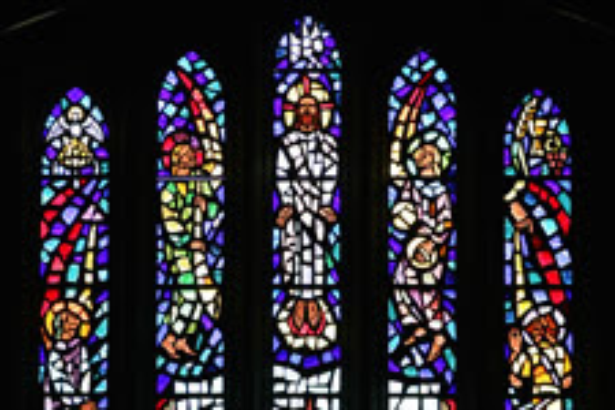
|
| Click to View Slideshow on Reclaiming the Promise of Ascension |
As dean of the chapel at Calvin College, religion professor Laura Smit considers herself a caretaker of Reformed identity. So when she noticed that most faculty statements of faith were about creation, she decided to highlight a neglected theological treasure—the ascension.
She formed an interdisciplinary faculty study group. Profs loved sharing ideas about what it means that Jesus has a body, right now, and how heaven is somehow more real than our cosmos.
Students, however, were completely bored with the chapel series Smit planned, Hebrews: Christ as Mediator of God’s Grace.
“I realized that students didn’t think they need any mediator between them and God. They see God as temporal, responsive, and changing with them. God the Father seems so easily accessible that they see no need for a high priest who intercedes for us,” Smit says.
By not fully understanding the ascension, many Christians miss out on deeper experiences of corporate prayer and worship. They also miss out on the full blessings of union with Christ.
Bring back the awe
Churches used to focus so much on making worship reverent and holy that visitors sometimes felt out of place or unwelcome. Today, Smit notes, churches try so hard to make people feel comfortable that the awe has eroded.
“Cultivate a sense of awe and wonder at our reception in God’s presence. Preach that God is transcendent, Other, a consuming fire,” Smit says. Unless worshipers see that God is radically unlike them, they can’t appreciate the wonder of Christ’s ongoing mediation.
Another awe-building strategy is to rethink the meaning of Christ’s resurrection. It’s not just about your salvation.
“When worshipers say ‘Christ has died; Christ is risen; Christ will come again,’ are they thinking only of Christ walking out of a tomb? Or do they also see with the eyes of faith Christ exalted at the right hand of the Father, praying on their behalf and advancing his kingdom for the sake of all?” Jack Van Marion asks. He pastors Calvary Christian Reformed Church in Edina, Minnesota, and teaches at the Institute for Worship Studies, Florida campus.
He sometimes opens the worship by welcoming people in the name of Christ and encouraging them to see Jesus as the great Liturgist or High Priest, standing in their midst, welcoming them, and lifting them into the Father’s presence.
Useful Resources for Planning Ascension Services
You can use these service plans, sermon and Scripture ideas, songs, prayers, and visual art ideas in several ways. While they would be appropriate for planning an Ascension Sunday or Ascension Day service, they will also help you weave in ascension concepts throughout the church year.
SERVICE PLANS
The Calvin Institute of Christian Worship offers service plans designed around themes of
THE WORD
One way to help people understand that God is loving—but not tame—is to build on the interest sparked by the Narnia books, recent film, and BBC miniseries. Watch online videos of the Narnia education series at Trinity Episcopal Church in New York City. It will help you tease out how Aslan is like and unlike Christ.
Use this dramatic reading for Ascension Sunday or Ascension Day.
SONGS
Graham Redding wrote the text to this anthem for the 150th anniversary of St. John’s in the City Presbyterian Church in Wellington, New Zealand. The church was founded by some New Zealand’s earliest pioneers . Redding suggests changing the verse one references (flax, tartan, architectural flair) to symbols that fit your congregation.
Listen to songs recommended by hymn experts Carl P. Daw Jr. and Emily Brink for Ascension and Pentecost.
Good ascension songs in Sing! A New Creation include #154, “God Has Gone Up with Shouts of Joy!” (#154), “You Are Crowned with Many Crowns” (#158), and “Mayenziwe/Your Will Be Done” (#198).
“Christus Paradox” is especially apt for Ascension services. It also works well for Easter, Christ the King Sunday (last one before Advent), and Christmas. “Sometimes a certain anthem just clicks. ‘Christus Paradox' lit a fire. We've sold 35,000 copies of the Dunstan/Fedak version. When you consider that the average church choir has 20 members, that's a lot of copies,” says Bob Batastini, vice president and senior editor of GIA Publications in Chicago, Illinois.
Though the rich text of Sylvia Dunstan's “Christus Paradox,” written in 1991, was first sung to the 17th century hymn tune WESTMINSTER ABBEY, that tune didn't convey the full impact of Dunstan's poetic words. So the Calvin Institute of Christian Worship commissioned Alfred V. Fedak to compose a new tune in the choral music series it jointly publishes with GIA.
Bach’s Choral Evensong for Ascension is another good choir choice.
PRAYERS
Here’s a prayer from the Church of the West Indies:
May your Spirit make us wise;
may your Spirit guide us;
may your Spirit renew us;
may your Sprit strengthen us
so that we will be strong in faith;
discerning in proclamation;
courageous in witness;
persistent in good deeds.
VISUALS
Get banner-making ideas from this Ascension Day print.
License the use of creative, Christian, contemporary art through Eyekons, an online gallery of original art made through the eyes of faith.
Search out public domain images on Wikipedia and in the Pitts Theology Library Digital Image Archive.
Check your language
Speaking of Jesus only in the past tense makes people think of him as someone in a book, a historical character who lived 2,000 years ago. This past tense emphasis leads believers to think that Christ’s work ended on the cross. Worship then seems like something we do for God, not something we join God in.
However, as the Gospels, Acts, Paul’s letters, Hebrews, Revelation, and ancient creeds proclaim, Christ ascended into heaven…and he is still there, enthroned next to the Father. “That’s not just a line of poetry!” Smit says.
Some people wonder how, if Jesus is physically absent from earth, we can know him other than as someone we read about in the Bible. Here again, be clear in how you speak of Jesus. Christ is fully human and fully divine. In his divine nature, he is present to us now.
Be clear as well what you mean by “Christ’s body.” Van Marion notes the Bible offers three meanings. Christ’s glorified, resurrected body is in heaven. The church is his body on earth. Through partaking of bread and wine, his flesh and blood, we experience union with Christ.
Fuzzy thinking about who and where God is produces prayer problems. Christians profess to believe in one God, Father, Son, and Holy Spirit, but sometimes worry that it’s “not correct” to pray to Jesus. Actually, it’s fitting to address intercessions to Jesus because he suffered the same pain and temptations that we do. And because Jesus is already in heaven, mediating for us and perfecting our prayers, we don’t have to worry over every word.
Still, Smit pleads, when you lead in public prayer, aim for precision. You don’t have to stick to a single formula (“Father, we pray to you in the name of Jesus and through the power of the Spirit”). After all, the Son and Spirit are fully God and equally worthy of worship. If you want to directly address more than one person of the Trinity, do it clearly, rather than morphing the prayer from Jesus to the Father and so on.
Talk about heaven
To be astounded by how Christ bridges the gap between divine majesty and “frail creatures of dust," you need to feel okay about looking forward to heaven.
Some believers think so much about heaven that they deny what’s good about creation and neglect their call to help transform a fallen world. But it’s not anti-incarnational or escapist to see yourself as a citizen of heaven, which is why Van Marion often reminds worshipers of their citizen status.
“Christ is our flesh in heaven. His sovereignty as King applies in all we do and experience, whether we’re ill, feeling overwhelmed, or approaching death. The risen, ascended, glorified Christ in his human nature points to the future, when all Christians will be clothed with resurrected, glorified bodies,” he says.
As Nathan Bierma explains in Bringing Heaven Down to Earth, “The promise of heaven is intended to make us itch for heaven, thirst for it, long for it, to have a holy restlessness as we live…. in two worlds at once, the already and the not yet…. God will one day restore planet earth….with the harmony of shalom, the way things are supposed to be.”
So don’t hold back on prayers, songs, and sermons about how wonderful it will be to join “the joyful assembly” (Hebrews 12:22), see Jesus face to face, and know as we are known.
Learn More
See the Ascension Resource Guide.
Study Graham Redding’s book Prayer and the Priesthood of Christ in the Reformed Tradition.
Other helpful books on understanding the ascension include:
- Ascension and Ecclesia: On the Significance of the Doctrine of the Ascension for Ecclesiology and Christian Cosmology by Douglas Farrow
- Bringing Heaven Down to Earth: Connecting This Life to the Next by Nathan Bierma
- Christ, Baptism and the Lord’s Supper: Recovering the Sacraments for Evangelical Worship by Leonard Vander Zee
- Jesus Ascended: The Meaning of Christ’s Continuing Incarnation by Gerrit Dawson
Either on your own or with a Bible study group, read and discuss ascension-related passages:
- Christ shares our humanity: Hebrews 2 and 3
- Christ ascended bodily into heaven: Matthew 28:16-20; Mark 16:19; Luke 24:50-53; John 20:17; Acts 1:1-10, 21-22.
- Christ, who is both King and Lamb, is Lord of all: Colossians 1:15-23; Revelation 4 and 5
- Christ represents us to God: Romans 8:34; Hebrews 7:23-25, 9:24; 1 John 2:1-2
- Christ is our heavenly High Priest: Hebrews 4:14-10:10
- Christ remains present with us in spirit: John 16; Ephesians 3:14-2
- We are raised with Christ the King: Ephesians 1:15-2:10
View Ascension Day vestments and paraments at Trinity Lutheran Church in Detroit, Michigan. Read aboutAscension Day customs around the world.
Start a Discussion
- What themes in this story surprised you? Which aspects of Christ’s ascension get little attention in your congregation?
- How would your congregation’s worship and faith life change if you spent more time talking about Christ’s vicarious humanity or role as priest and mediator? How might this doctrine affect worship, the Lord’s Supper, prayer, pastoral care, or how people view salvation, discipleship, or heaven?
- Graham Redding says that in the Middle Ages, the priest, not Christ, was seen as leading worship. Who do you see as leading worship in your church? Is Christ the mediator or object of this worship?
Share Your Wisdom
What is the best way you’ve found to celebrate the ascension in worship?
- Can you share any visual arts resources, song suggestions, or drama ideas that helped your congregation see the meaning of Christ’s ascension?
- Did you consult with other congregations or pastors to see how they understand and teach the doctrine of ascension—and how this plays out in their worship services?
- If you started observing Ascension Sunday or Ascension Day in a new way, how did you get people interested?